
# Packaging Machine for Spices & Seasonings: Semi-Auto Solutions for Small Producers
Spice and seasoning packaging is one of those categories that looks deceptively simple from the outside. You're filling jars or bags with dry, free-flowing powder—how hard can it be? The reality is that spice packaging is a minefield of unique challenges: ultra-fine powders that create dust clouds, volatile oils that corrode seals, hygroscopic ingredients that clump on contact with moisture, and strict labeling requirements that leave zero margin for error. For small spice blenders, artisan seasoning companies, and regional co-packers, finding packaging equipment that handles all of these realities without requiring a massive capital outlay is a genuine struggle.
If you're currently hand-filling spice jars, scooping seasoning blends into bags with a kitchen scale, or running a tabletop filling station that can barely keep up with your wholesale orders, you already know the pain points. Dust coats every surface in your facility. Your operators sneeze through their masks. Fill weights swing wildly between packages. Labels get applied crooked during the afternoon shift when fatigue sets in. And the moment you land a new retail account that needs 5,000 units per month, your entire operation buckles under the demand.
The good news is that semi-automatic packaging equipment is specifically designed to solve these problems at a price point that makes sense for small and growing operations. Here's everything you need to know about automating your spice and seasoning packaging line.
## Table of Contents
1. [Why Spice Packaging Is Uniquely Challenging](#section1)
2. [Common Pain Points for Small Spice Producers](#section2)
3. [Manual vs Semi-Auto: The Real Cost of Hand Filling](#section3)
4. [Equipment Recommendations for Spice Operations](#section4)
5. [Dust Control and Facility Cleanliness](#section5)
6. [ROI Insights: What Small Producers Can Expect](#section6)
7. [Conclusion](#conclusion)
---
## 1. Why Spice Packaging Is Uniquely Challenging {#section1}
Spices and seasonings present a set of packaging challenges that distinguish them from virtually every other food category. Understanding these challenges is the first step toward selecting equipment that actually solves your problems instead of creating new ones.
**Dust generation** is the defining challenge of spice packaging. Finely ground powders like turmeric, paprika, cumin, and chili powder create airborne particulate matter during every stage of the filling process. This dust isn't just a cleanliness problem—it's a workplace safety concern (some spice dusts are respiratory irritants), a contamination risk (cross-contact between allergens), and a seal-integrity issue (dust particles trapped in heat seals create weak points that fail under pressure). Equipment designed for spice packaging must include dust extraction, anti-static features, and precision filling heads that minimize airborne dispersion.
**Product variability** makes precision filling difficult. Spice blends can range from free-flowing granules (like sesame seeds or dried oregano) to extremely fine powders (like ground cinnamon or garlic powder) to sticky, oil-rich pastes (like curry pastes or wet rubs). A single producer might need to package products across this entire spectrum on the same equipment. Unlike packaging equipment for uniform products like nuts or grains, spice packaging machines need flexible filling systems that adapt to different flow characteristics.
**Hygroscopic behavior** creates time-sensitive production windows. Many spices absorb moisture from the air rapidly, leading to clumping, discoloration, and flavor degradation. This means your packaging process must be fast, your facility humidity must be controlled, and your packaging materials must provide an excellent moisture barrier. Semi-automatic equipment that speeds up the filling-to-seal cycle directly protects product quality.
**Oil content** in spices like cinnamon, clove, and nutmeg can corrode certain seal materials and create slick surfaces that interfere with consistent filling weights. Equipment with food-grade stainless steel 316L contact surfaces and chemically resistant seal components is essential for longevity and food safety.
**Regulatory labeling complexity** rivals that of pharmaceuticals. A single seasoning blend might require an ingredient list with 15+ components, allergen declarations (the FDA's "Big 9" allergens appear frequently in spice blends), nutrition facts panels, net weight declarations, lot codes, and best-by dates. Getting any of these wrong creates compliance risk.
---
## 2. Common Pain Points for Small Spice Producers {#section2}
Small spice and seasoning producers share a common set of frustrations that larger operations solve with expensive fully automated lines. Here are the issues we hear about most frequently:
**Dramatic fill weight variation** is the number one complaint. When filling by hand or with basic volumetric equipment, spice weights can vary by ±10–20%. For a product selling at $8.99 per 2-ounce jar, that kind of variation means you're either giving away 10–20% of your product (if you overfill to avoid underweight complaints) or risking FDA violations (if you don't). Semi-automatic weighing systems bring that variation down to ±1–2%, which has an immediate and measurable impact on your margins.
**Dust contamination** makes facilities unpleasant and creates cross-contact risks. When you're packaging cumin in the morning and white pepper in the afternoon, residual dust from one product contaminates the next. For producers with allergen-containing blends (sesame, mustard, celery), this isn't just a quality issue—it's a potential recall trigger. Semi-automatic systems with dedicated hoppers and dust extraction minimize cross-contact.
**Labor-intensive hand filling** creates a hard ceiling on production capacity. One operator hand-filling 2-ounce jars at a reasonable pace can complete roughly 60–80 jars per hour. That same operator managing a semi-automatic filling station can produce 200–300 jars per hour with better accuracy. When a retailer orders 3,000 units for a seasonal promotion, hand filling turns into a crisis that requires overtime, temporary workers, or missed deadlines.
**Labeling inconsistency** is both an aesthetic and compliance problem. Hand-applied labels on small jars are notoriously difficult to position consistently, especially when the jar has a curved surface or the label needs to wrap around. Crooked labels signal low quality to consumers and can cause barcode scanning failures at retail. Semi-automatic labeling machines deliver consistent placement within ±1mm every time.
**Bag and pouch sealing quality** varies enormously in manual operations. If you're selling spice blends in stand-up pouches, the seal must be clean, centered, and strong enough to survive shipping and retail handling. Hand heat-sealers are prone to inconsistent pressure and temperature, leading to seal failures that result in spilled product, customer complaints, and retail returns.
---
## 3. Manual vs Semi-Auto: The Real Cost of Hand Filling {#section3}
Let's put real numbers to the comparison. Consider a small artisan spice company packing 4,000 2-ounce jars per month across eight SKUs.
**Manual filling** typically involves:
- An operator scooping spice into jars using a volumetric scoop or kitchen scale
- Manual tamping to settle the product
- Hand-applied labels (or a slow tabletop labeler)
- Manual capping
- Visual quality checks
At this volume, manual filling typically requires 2 part-time operators working roughly 25 hours per week each. At $16/hour with minimal benefits, that's approximately **$41,600 per year in labor costs**. Fill weight variation of ±12% means roughly 480 jars per month fall outside acceptable tolerance—some overfilled (giving away product), some underfilled (risking complaints and regulatory issues). The combined cost of overfill giveaway and rework is approximately **$8,000–$12,000 per year**.
**Semi-automatic filling** with the right equipment typically involves:
- A semi-automatic auger or multi-head weigher filling station
- A semi-automatic capping machine
- An automatic wrap-around or top-label applicator
- Inline checkweighing
This setup lets **one operator** manage the same 4,000 jars per month in roughly 50% of the time, with fill weight variation under ±2%. The annual labor cost drops to approximately **$16,000–$20,000**, and giveaway/shrink costs fall by 85%.
The equipment investment for a basic semi-automatic spice filling line typically ranges from **$18,000–$45,000** depending on product characteristics and fill formats, which means most small producers see a full payback within 6–12 months.
---
## 4. Equipment Recommendations for Spice Operations {#section4}
Here's what we recommend for different types of small spice and seasoning operations:
### For Ground Spices in Jars (2 oz, 4 oz, 8 oz)
A semi-automatic auger filler is the gold standard for fine spice powders. This typically includes:
- **[Semi-automatic auger filler](/food-packaging-machines/)** — Uses a precision auger screw to dispense measured volumes of powder into jars. Auger fillers are specifically designed for fine, dusty products and can achieve fill accuracy of ±1% with proper calibration. Look for models with dust extraction ports and tool-free changeover between jar sizes.
- **[Semi-automatic capping machine](/food-packaging-machines/)** — Torque-limited capping ensures consistent tightness without stripping threads on plastic caps. Critical for spices because over-tightened caps compress the product and create clumping, while under-tightened caps allow moisture ingress.
- **[Automatic label applicator](/labeling-machines/)** — A wrap-around label applicator handles the cylindrical surface of spice jars with consistent placement every time. Look for systems with integrated thermal transfer printers for variable data (lot codes, best-by dates, UPC codes).
### For Spice Blends in Stand-Up Pouches
For blended seasonings, rubs, and multi-ingredient mixes, a combination weigher or multi-head weigher provides superior accuracy:
- **[Multi-head weigher](/food-packaging-machines/)** — A 10-head or 14-head combination weigher handles the varied particle sizes in spice blends (think: a rub containing salt crystals, dried herbs, and ground pepper) with precision that auger fillers can't match. The weigher dispenses the exact target weight by combining portions from multiple hoppers.
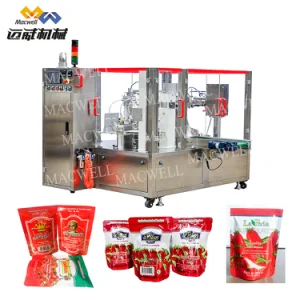
- **Pouch sealing station** — Pre-made pouch fill-and-seal machines or semi-automatic VFFS systems create retail-ready bags. For oil-rich blends, look for machines with heated jaw options that can seal through residual oil on the seal area.
- **[Label applicator](/labeling-machines/)** — Top-label applicators place branding labels on the face of stand-up pouches, while back-label applicators handle the required nutrition facts and ingredient information.
### For Seasoning Sachets and Single-Serve Packets
For producers packaging individual seasoning packets for food service or meal kit applications:
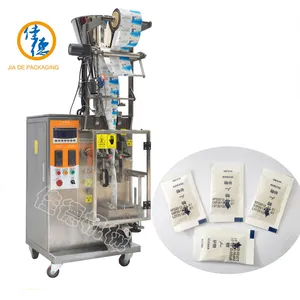
- **Vertical form fill seal (VFFS) machine** — Creates small sachets from film rolls, fills with measured seasoning, and seals. A [small-scale VFFS system](/food-packaging-machines/) handles sachet sizes from 1 gram to 50 grams and can produce 30–60 packets per minute.
- **Multi-head weigher** — Essential for accurate dosing of multi-component blends where particle size variation is significant.
- **Metal detector** — Industry best practice for any packaged food product, including spices. Catches any metal contamination from grinding equipment before it reaches consumers.
### Building a Complete Line
For producers ready to invest in a [complete packaging line](/production-lines/), the combination of a multi-head weigher or auger filler, capping/sealing station, labeler, and checkweigher creates a semi-automatic system that can handle 20–60 units per minute depending on container format. This throughput is typically 3–4x faster than manual filling while requiring fewer operators.
---
## 5. Dust Control and Facility Cleanliness {#section5}
Dust management deserves special attention in spice packaging because it directly impacts product quality, worker safety, and your ability to meet retail co-packing requirements.
**Integrated dust extraction** is a must-have feature on any spice filling equipment. Modern semi-automatic fillers include dust collection ports that connect to a portable or centralized extraction system, capturing airborne particles at the point of generation rather than letting them settle on every surface in your facility.
**Enclosed filling paths** minimize the distance product travels through open air. Equipment with tube-style auger fillers or enclosed vibratory feeders keeps the spice contained from hopper to container, reducing dust dispersion by 70–80% compared to open scooping.
**Anti-static features** prevent fine spice powders from clinging to equipment surfaces. Static charge is a surprisingly significant issue with spices like paprika and chili powder, which develop strong electrostatic attraction during handling. Anti-static bars and grounding systems integrated into filling equipment keep product flowing smoothly.
**Facility humidity control** is essential for hygroscopic spices. Maintain relative humidity below 45% in your packaging area to prevent clumping and moisture-related quality degradation. While this is a facility-level investment rather than an equipment purchase, your packaging equipment supplier should help you plan for it.
---
## 6. ROI Insights: What Small Producers Can Expect {#section6}
Here's a realistic ROI model for a small spice company transitioning from manual to semi-automatic packaging:
**Current State (Manual):**
- Production: 4,000 jars/month (48,000 jars/year)
- Labor: 2 operators × 25 hours/week × 50 weeks × $16/hour = $40,000/year
- Overfill giveaway (12% average overfill): $9,600/year
- Rework and quality failures: $3,200/year
- Total packaging cost: ~$52,800/year
**Semi-Automatic State:**
- Production: 4,000 jars/month (with capacity for 8,000+)
- Labor: 1 operator × 15 hours/week × 50 weeks × $16/hour = $12,000/year
- Overfill giveaway (2% average overfill): $1,600/year
- Rework and quality failures: $400/year
- Equipment cost: $30,000 (amortized over 7 years = $4,286/year)
- Maintenance and consumables: $2,400/year
- Total packaging cost: ~$20,686/year
**Annual Savings: $32,114**
**Payback Period: ~11 months**
**7-Year Net Benefit: $194,098**
These numbers are conservative. Most small producers also benefit from the ability to take on new retail accounts (which typically require consistent fill weights and professional labeling that manual operations can't reliably deliver), reduced worker compensation claims related to repetitive strain injuries, and the ability to run shorter, more frequent production batches without the labor overhead.
---
---
### Recommended Equipment
 ---
### Recommended Equipment
---
### Recommended Equipment
 ## Conclusion {#conclusion}
Spice and seasoning packaging demands equipment that can handle fine powders, manage dust, accommodate variable product characteristics, and deliver the precision fill weights that retail customers require. Semi-automatic packaging machines offer small spice producers a realistic path to better efficiency, dramatically lower costs, and professional-quality presentation—without requiring the investment or floor space of fully automated lines.
Whether you're a boutique spice blender packaging 500 jars a week or a regional seasoning company producing 10,000 sachets a month, the right semi-automatic equipment combination will pay for itself quickly while freeing your team to focus on what they do best: creating exceptional products.
**Ready to upgrade your spice packaging operation?** [Request a free quote](/request-quote/) from SPS and let our team design a semi-automatic packaging solution tailored to your specific products, container formats, and production volumes.
---
## Related Resources
- [Semi-Automatic Packaging Machines for Small Businesses](/solutions/) — Our complete lineup of entry-level automation
- [Multi-Head Weighers for Precision Filling](/food-packaging-machines/) — Accurate weighing for spice blends and seasonings
- [Labeling Machines](/labeling-machines/) — Compliance-ready labeling for spice jars, pouches, and sachets
- [Complete Production Lines](/production-lines/) — End-to-end packaging solutions for growing spice operations
## Conclusion {#conclusion}
Spice and seasoning packaging demands equipment that can handle fine powders, manage dust, accommodate variable product characteristics, and deliver the precision fill weights that retail customers require. Semi-automatic packaging machines offer small spice producers a realistic path to better efficiency, dramatically lower costs, and professional-quality presentation—without requiring the investment or floor space of fully automated lines.
Whether you're a boutique spice blender packaging 500 jars a week or a regional seasoning company producing 10,000 sachets a month, the right semi-automatic equipment combination will pay for itself quickly while freeing your team to focus on what they do best: creating exceptional products.
**Ready to upgrade your spice packaging operation?** [Request a free quote](/request-quote/) from SPS and let our team design a semi-automatic packaging solution tailored to your specific products, container formats, and production volumes.
---
## Related Resources
- [Semi-Automatic Packaging Machines for Small Businesses](/solutions/) — Our complete lineup of entry-level automation
- [Multi-Head Weighers for Precision Filling](/food-packaging-machines/) — Accurate weighing for spice blends and seasonings
- [Labeling Machines](/labeling-machines/) — Compliance-ready labeling for spice jars, pouches, and sachets
- [Complete Production Lines](/production-lines/) — End-to-end packaging solutions for growing spice operations
6-Column Stick Pack Machine
6-column stick pack for fine spice powders with integrated auger filler.
View Details →
Vertical Sachet Fill & Seal Machine
Vertical sachet for single-portion seasoning packets and spice blends.
View Details →Need Packaging Equipment?
SPS helps small food manufacturers source reliable packaging equipment at factory prices.
Get a Free Quote →