
# Semi-Automatic vs Automatic Labeling Machine: A Complete Comparison
Labeling is one of those production steps that small manufacturers often underestimate—until they find themselves spending hours manually applying labels, watching their product quality suffer from inconsistent label placement, or watching their production speed bottleneck at the labeler because they bought the wrong configuration.
The choice between semi-automatic and automatic labeling machines is one of the most common equipment decisions small food manufacturers face. It's not a trivial one: the right choice can save you thousands of dollars per year in labor while dramatically improving your production throughput. The wrong choice can leave you with a machine that's either too slow to support your growth or too expensive for your current volume.
This guide breaks down exactly what each type offers, where they differ, and how to decide which one belongs in your production line.
## Table of Contents
1. [What Is a Semi-Automatic Labeling Machine?](#section1)
2. [What Is an Automatic Labeling Machine?](#section2)
3. [Head-to-Head Comparison](#section3)
4. [When to Choose Semi-Automatic](#section4)
5. [When to Choose Automatic](#section5)
6. [The ROI Calculation](#section6)
7. [Conclusion](#conclusion)
---
## 1. What Is a Semi-Automatic Labeling Machine? {#section1}
A semi-automatic labeling machine requires an operator to manually load products (containers, packages, or bags) into the machine, which then applies the label automatically. The operator's hands are the product feeding mechanism—the machine handles label application, but not product handling.
**How it works**: The operator places a product onto a labeling platform, jog wheel, or conveyor section. The machine detects the product's presence, dispenses the label from the roll, and applies it using a tamp or blow applicator. The operator removes the labeled product and loads the next one.
**Key characteristics**:
- Labeling speeds of 20–60 labels per minute (operator-limited)
- Manual product loading and unloading
- Single-label application (top, bottom, wrap, front, back)
- Price range: $3,000–$15,000
- Compact footprint—often benchtop-mountable
- Ideal for small production batches, product sampling, or specialty runs
**Common configurations**:
- **Tamp-blow labelers**: A tamp pin pushes the label against the product surface with a puff of air. Best for flat surfaces and products where label placement must be precise.
- **Roll-fed labelers**: Label is peeled from the liner and roll-fed onto the product. Faster than tamp-blow but less precise on uneven surfaces.
- **Wrap-around labelers**: The product rotates as the label is applied, creating a full-wrap label. Common for cylindrical containers.
Semi-automatic labelers are the workhorse of low-volume production and are an excellent starting point for manufacturers who are still in the startup phase, running small batch specialty products, or developing their market before scaling.
---
## 2. What Is an Automatic Labeling Machine? {#section2}
An automatic labeling machine handles both label application and product feeding without continuous operator involvement. Products are loaded onto an in-feed conveyor, and the machine applies labels continuously as the conveyor moves products through the labeling station.
**How it works**: Products on an in-feed conveyor travel to the labeling station. A sensor detects each product and triggers label application at the precise moment the product reaches the label head. Labels are dispensed, peeled, and applied continuously. An operator monitors the process and loads products onto the conveyor but does not handle individual label applications.
**Key characteristics**:
- Labeling speeds of 40–200+ labels per minute (machine-limited)
- Continuous product feeding via conveyor
- Multiple labeling stations possible (apply labels to front and back in one pass)
- Advanced label placement accuracy (typically ±1mm)
- Price range: $12,000–$50,000 for most food applications
- Requires more floor space than semi-automatic models
- Designed for production runs of 1,000+ units consistently
**Common configurations**:
- **In-line labelers**: Products travel in a single file on a conveyor. Compact and suitable for most small-to-mid-size operations.
- **Rotary labelers**: Products rotate as they pass through the labeling station. Higher speeds but larger footprint.
- **Front-and-back labelers**: Two labeling stations apply labels to opposite sides of the product in a single pass. Essential for products requiring nutrition facts on the back and branding on the front.
Automatic labelers represent the standard for established food manufacturers running consistent production volumes. They're designed for production runs where the efficiency gain from automated product feeding justifies the higher capital cost.
---
## 3. Head-to-Head Comparison {#section3}
| Factor | Semi-Automatic | Automatic |
|--------|---------------|----------|
| Speed | 20–60 labels/min | 40–200+ labels/min |
| Operator requirement | Continuous during labeling | Monitor and load; no per-unit handling |
| Label accuracy | ±2–3mm | ±1mm |
| Footprint | Compact (benchtop option) | Moderate to large |
| Price range | $3,000–$15,000 | $12,000–$50,000 |
| Changeover time | 15–30 minutes | 30–60 minutes |
| Multi-side labeling | No (single station) | Yes (with dual-station config) |
| Integration with production lines | Standalone | Direct conveyor integration |
| Best for batch size | Under 3,000 units | Over 3,000 units consistently |
| Maintenance complexity | Low | Moderate |
**The speed comparison requires context.** A semi-automatic labeler at 40 labels per minute sounds slow—but if your production line itself runs at 30 units per minute, the labeler isn't your bottleneck. The relevant question isn't "which machine is faster" but "which machine matches my production line speed without creating a bottleneck."
---
## 4. When to Choose Semi-Automatic {#section4}
Semi-automatic labeling is the right choice for most small food manufacturers in the startup and early growth phases. Specifically, consider semi-automatic when:
**You're running small batches or short production runs.** If your typical run is under 2,000 units and you run multiple SKUs regularly, the changeover efficiency of semi-automatic equipment (15–30 minutes) often beats automatic equipment (30–60 minutes). Short runs don't give automatic equipment enough time to amortize its changeover cost.
**Your production volume is inconsistent.** If you're running promotional batches, seasonal products, or products for specific retail slots that come and go, a semi-automatic machine is more flexible. You can change products quickly, handle irregular scheduling, and avoid the pressure of keeping a high-speed automatic line fed.
**You're still developing your market.** At early stages, production volume doesn't justify the capital cost of automatic equipment. A $5,000 semi-automatic labeler lets you get to market professionally without tying up capital in equipment you're not yet running at full capacity.
**You have limited floor space.** Semi-automatic labelers, particularly benchtop models, can be set up in a corner of your production space and moved as needed. Automatic labelers require dedicated conveyor runs and more permanent installation.
**You need label flexibility for product development.** If you're frequently testing new products, new label designs, or new package formats, the quick changeover of a semi-automatic machine is a significant advantage. You can test a50-unit run in15 minutes; doing the same on an automatic line might require an hour of changeover time.
**Budget is a constraint.** Semi-automatic labelers start at $3,000–$5,000 for basic models. Automatic equipment typically starts at $12,000–$15,000 for production-capable models. If your labeling needs are modest, the capital savings from a semi-automatic machine can be deployed elsewhere in your business.
---
## 5. When to Choose Automatic {#section5}
Automatic labeling becomes the better choice when your production operation crosses certain thresholds. Consider automatic equipment when:
**Your consistent production volume exceeds 3,000–5,000 units per month.** At this volume, the labor savings from automatic labeling typically justify the higher equipment cost within 12–18 months. A single operator monitoring an automatic labeler can feed products continuously; the same operator running a semi-automatic labeler is physically limited to 40–60 products per minute.
**Labeling speed is your production bottleneck.** If your packaging line runs at 60 packages per minute but your labeler can only apply40 labels per minute, the labeler is capping your throughput. Upgrading to an automatic labeler removes the bottleneck and lets your line run at its rated speed.
**You need multi-side labeling in a single pass.** If your product requires a front label and a back label (common for food products with branding on front and nutrition/ingredient information on back), a single-station semi-automatic labeler cannot do this efficiently. You either apply labels in two passes (halving your effective speed) or have a second operator. An automatic dual-station labeler applies both in a single pass.
**You have high cosmetic standards for label quality.** Automatic labelers deliver tighter placement tolerances (±1mm vs. ±2–3mm) and more consistent application pressure. If you're supplying retailers with strict planogram requirements or products where label appearance is a key brand attribute, automatic labeling provides the consistency you need.
**You're integrating with a continuous production line.** If your packaging line is automated downstream (conveyor-fed packaging, automatic case packing, palletizing), manual product feeding at the labeler creates a manual bottleneck in an otherwise automated system. Integrating an automatic labeler maintains your line's efficiency.
**Your run lengths are long.** If your typical production run is 8–12 hours on a single SKU, the changeover penalty of automatic equipment is negligible compared to the per-unit labor savings. The math works clearly in automatic equipment's favor for long, consistent runs.
---
## 6. The ROI Calculation {#section6}
The financial case between semi-automatic and automatic labeling hinges on labor efficiency. Here's the framework for calculating which machine pays off for your operation:
**Calculate your labor cost per label:**
- Semi-automatic: Assume1 operator at $20/hour (fully loaded cost) at 40 labels/minute = $0.50 per label in labor
- Automatic: Assume 1 operator at $20/hour at100 labels/minute = $0.20 per label in labor
**Calculate the volume crossover point:**
- Assume a $10,000 price difference between semi-automatic and automatic ($5,000 vs. $15,000)
- Labor savings per label: $0.30 ($0.50 - $0.20)
- Break-even volume: $10,000 / $0.30 = 33,333 labels
This simplified calculation suggests that automatic labeling pays for itself within roughly 33,000 labels when your production is running at the speeds assumed. Adjust the numbers for your actual labor cost and labeling speed—and remember to factor in your floor space costs, conveyor costs for automatic equipment, and any integration costs—before making your decision.
**Additional factors that improve automatic equipment ROI:**
- Reduced label waste from misalignment (typically 1–3% of labels on semi-automatic equipment)
- Lower turnover and training costs (automatic machines require less operator skill)
- Improved throughput that can reduce other production costs (fewer machine-hours needed)
---
---
### Recommended Equipment
 ---
### Recommended Equipment
---
### Recommended Equipment
 ## Conclusion {#conclusion}
The semi-automatic vs. automatic labeling decision is fundamentally about your production volume and how your labeling station fits into your overall production line. For most small food manufacturers in early growth stages, a semi-automatic labeler is the right choice—it provides professional labeling quality at a manageable capital cost, with the flexibility to handle small batches and frequent changeovers.
Automatic labeling becomes the right choice when your consistent production volume crosses the 3,000–5,000 unit per month threshold, when labeling speed is your bottleneck, or when you need multi-side labeling in a single production pass. At that stage, the labor efficiency gains and throughput improvements typically justify the higher capital investment within 12–18 months.
The key is to buy the equipment that matches your current stage—not the equipment you hope to need in two years. A semi-automatic labeler at the right time is a better investment than an automatic labeler that sits underutilized.
Not sure which labeling solution fits your production line? Our specialists can help you evaluate your options based on your specific products, volumes, and line configuration. [Request a quote](/request-quote/) to start the conversation.
---
## Related Products
- [Food Packaging Machines](/food-packaging-machines/) — Complete range of food packaging equipment
- [Complete Production Lines](/production-lines/) — End-to-end packaging line configurations
- [Semi-Automatic Labeling Machines](/labeling-machines/semi-automatic-labeling/) — Compact, affordable labeling for growing manufacturers
- [Automatic Labeling Systems](/labeling-machines/automatic-labeling/) — High-speed solutions for established production lines
- [Labeling Accessories and Supplies](/solutions/) — Label stock, print-and-apply systems, and consumables
## Conclusion {#conclusion}
The semi-automatic vs. automatic labeling decision is fundamentally about your production volume and how your labeling station fits into your overall production line. For most small food manufacturers in early growth stages, a semi-automatic labeler is the right choice—it provides professional labeling quality at a manageable capital cost, with the flexibility to handle small batches and frequent changeovers.
Automatic labeling becomes the right choice when your consistent production volume crosses the 3,000–5,000 unit per month threshold, when labeling speed is your bottleneck, or when you need multi-side labeling in a single production pass. At that stage, the labor efficiency gains and throughput improvements typically justify the higher capital investment within 12–18 months.
The key is to buy the equipment that matches your current stage—not the equipment you hope to need in two years. A semi-automatic labeler at the right time is a better investment than an automatic labeler that sits underutilized.
Not sure which labeling solution fits your production line? Our specialists can help you evaluate your options based on your specific products, volumes, and line configuration. [Request a quote](/request-quote/) to start the conversation.
---
## Related Products
- [Food Packaging Machines](/food-packaging-machines/) — Complete range of food packaging equipment
- [Complete Production Lines](/production-lines/) — End-to-end packaging line configurations
- [Semi-Automatic Labeling Machines](/labeling-machines/semi-automatic-labeling/) — Compact, affordable labeling for growing manufacturers
- [Automatic Labeling Systems](/labeling-machines/automatic-labeling/) — High-speed solutions for established production lines
- [Labeling Accessories and Supplies](/solutions/) — Label stock, print-and-apply systems, and consumables
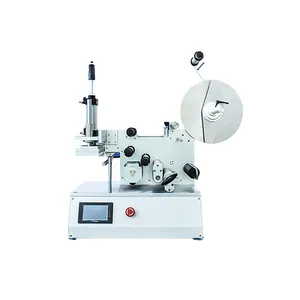
Desktop Semi-Automatic Labeler
The entry-level semi-auto labeler — perfect for under 5,000 units/month.
View Details →
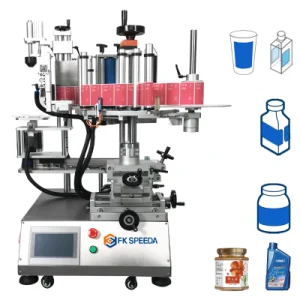
Automatic Round Bottle Wrap-Around Labeler
The automatic upgrade — handles 60+ bottles per minute for growing operations.
View Details →Need Packaging Equipment?
SPS helps small food manufacturers source reliable packaging equipment at factory prices.
Get a Free Quote →