
# Why Small Food Manufacturers Are Switching to Semi-Automatic Packaging Machines
Small food manufacturers across the United States are facing a pivotal moment. Labor costs have surged, skilled operators are harder to find than ever, and consumer demand for professionally packaged products continues to climb. If you're a small-batch producer who's still packaging by hand, you're likely watching larger competitors pull away—not because their products are better, but because their packaging is faster, more consistent, and more professional.
Semi-automatic packaging machines have quietly become the secret weapon for small food businesses that want to scale without breaking the bank. These machines don't require a dedicated operator for every station, they deliver consistent fill weights and seal quality that hand packing simply can't match, and they pay for themselves far faster than most owners expect. In this article, we'll explore why the shift is happening, what it costs, and how to make the transition without disrupting your production.
## Table of Contents
1. [The Hidden Cost of Hand Packing](#section1)
2. [What Semi-Automatic Packaging Actually Means](#section2)
3. [How Semi-Auto Equipment Solves Common Pain Points](#section3)
4. [Cost Comparison: Hand Packing vs. Semi-Auto Equipment](#section4)
5. [Real-World ROI: When Does the Investment Pay Off?](#section5)
6. [Choosing the Right Equipment for Your Operation](#section6)
7. [Conclusion](#conclusion)
---
## 1. The Hidden Cost of Hand Packing {#section1}
Most small food manufacturers underestimate what hand packing truly costs them. It's not just the hourly wages of the people doing the work—it's the cascade of secondary costs that eat into margins without showing up on a simple labor calculation.
**Weight inconsistency** is the silent profit killer. When two operators hand-fill the same product, they'll produce significantly different weights. Even the same operator will vary throughout the day as fatigue sets in. This means you're either overfilling (giving away 5–15% of your product) or risking FDA violations for underfilled packages. For a business packaging 1,000 units per week at $8 retail, an average overfill of just 8% means you're losing over $6,400 annually in free product.
**Speed limitations** cap your growth ceiling. A skilled hand packager can typically produce 200–300 finished units per hour for most dry food products. That sounds reasonable until you calculate that a single semi-automatic station can produce 600–1,000 units per hour with one operator. Your ceiling isn't just lower—it's cutting your revenue potential in half.
**Quality variation** damages your brand. Packages that bulge, wrinkle, or have uneven seals look amateur next to the crisp, consistent packaging of your competitors. Retail buyers notice, and so do consumers standing at the shelf choosing between your product and one that looks more professional.
**Labor dependency** creates operational fragility. If your primary packager calls in sick, takes vacation, or quits, your entire production line stops. This is an existential risk for small businesses that can't afford redundancy in every role.
---
## 2. What Semi-Automatic Packaging Actually Means {#section2}
Semi-automatic packaging equipment sits in the sweet spot between fully manual packing and expensive fully automated lines. The key distinction: a human operator performs some tasks (like loading product into the machine's hopper or placing pre-made pouches), while the machine handles the precision work (weighing, filling, sealing, and sometimes labeling).
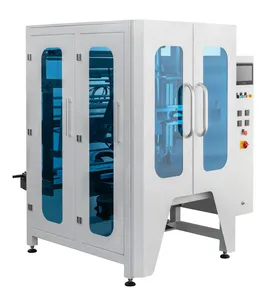
**A 2-in-1 Weigher and Packaging Machine**, for example, automatically weighs your product to precise tolerances and dispenses it into a bag or pouch. Your operator simply loads the hopper and manages the flow. The machine eliminates the guesswork of manual portioning while requiring minimal training to operate.
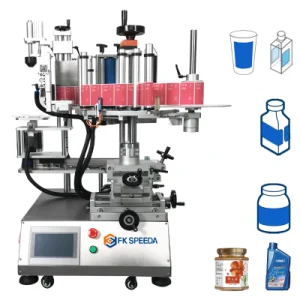
**Desktop Semi-Automatic Labelers** work on the same principle. An operator places the product or container into position, and the machine applies a perfectly aligned, consistent label every time. No more crooked labels, no more operator fatigue leading to misaligned branding.
The beauty of semi-automatic equipment is that it doesn't require a complete workflow overhaul. Most machines fit on an existing table or workbench, connect to standard 110V power, and can be up and running within hours of delivery. Your team doesn't need engineering degrees—they need about 30 minutes of hands-on training.
---
## 3. How Semi-Auto Equipment Solves Common Pain Points {#section3}
Small food manufacturers share a remarkably consistent set of frustrations, and semi-automatic equipment addresses each one directly.
**Inconsistent fill weights** disappear when you switch from hand scooping to an automated weighing system. Semi-automatic weighers deliver accuracy within ±1–2%, compared to the ±10–15% variation typical of hand filling. For a product sold by weight, this precision translates directly into compliance and profitability.
**Slow production throughput** is eliminated by machines that work at consistent speeds without fatigue. While your best hand packager might produce 250 bags per hour in the morning and drop to 150 by end of shift, a semi-automatic machine runs at 600+ bags per hour all day long—every day.
**Poor seal quality** is a common complaint with hand sealing equipment. Semi-automatic machines apply consistent heat, pressure, and dwell time to every seal, resulting in clean, professional closures that pass leak tests and look great on the shelf.
**Labeling errors and misalignment** become a thing of the past with semi-automatic labeling equipment. Whether you need front labels, back labels, or wraparound applications, these machines deliver consistent placement that makes your products look store-ready.
**Operator training time** is dramatically reduced. Semi-automatic machines are designed for simplicity. Most operators become proficient within a single shift, and the intuitive controls mean you're not dependent on specialized technicians for day-to-day operation.
---
## 4. Cost Comparison: Hand Packing vs. Semi-Auto Equipment {#section4}
Let's look at the real numbers. This comparison assumes a small manufacturer producing 1,000 units per day of dry food product in pouches.
**Hand Packing Operation:**
- 3 operators × $15/hour × 8 hours = $360/day
- Product overfill loss (8% average): ~$120/day in wasted product
- Defective packages (5% reject rate): ~$40/day in rework and waste
- **Total daily cost: ~$520/day**
- **Annual cost (250 working days): ~$130,000**
**Semi-Automatic Operation:**
- 1 operator × $15/hour × 8 hours = $120/day
- Product overfill loss (2% average): ~$30/day
- Defective packages (0.5% reject rate): ~$4/day in rework
- Equipment amortization ($12,000 machine over 3 years): ~$16/day
- **Total daily cost: ~$170/day**
- **Annual cost (250 working days): ~$42,500**
The math is stark. Semi-automatic equipment saves roughly **$87,500 per year** in this scenario. Even with a conservative estimate, most small manufacturers see annual savings between $40,000 and $80,000 after switching from hand packing to semi-automatic equipment. That's not a marginal improvement—it's a transformational change in your cost structure.
---
## 5. Real-World ROI: When Does the Investment Pay Off? {#section5}
Based on real customer data from small food manufacturers who've made the switch, here's what you can expect:
**Payback period:** Most operators recover their equipment investment within 3–6 months. The typical entry-level semi-automatic packaging machine costs between $5,000 and $15,000, with labeling equipment adding another $2,000 to $5,000. When you're saving $500+ per week in labor and product waste, the numbers work quickly.
**Production capacity increase:** Expect a 2–3× increase in throughput with the same or fewer operators. Many manufacturers report going from 1,000 units/day to 2,500–3,000 units/day after adding semi-automatic equipment.
**Employee satisfaction improvement:** Operators who move from repetitive manual scooping and sealing to managing a machine report significantly higher job satisfaction. They're doing more skilled work, and their bodies aren't taking the same physical toll.
**Retail buyer reception:** Multiple small manufacturers report that upgrading their packaging appearance with machine-applied labels and consistent bag fills helped them land new retail accounts. Professional-looking packaging opens doors that homemade-looking packages cannot.
**Scale readiness:** Semi-automatic equipment is the bridge to full automation. Once you've established processes and demand with semi-auto equipment, transitioning to fully automatic lines is a natural next step—rather than jumping from hand packing directly to a $100,000+ automated system.
---
## 6. Choosing the Right Equipment for Your Operation {#section6}
Not every semi-automatic machine is right for every operation. Here's how to think about equipment selection for small food businesses.
**Start with your product.** Granular products like nuts, coffee beans, and cereal need a machine with a vibrating or auger-based feeding system. Powders like protein mix or spice blends require dust containment. Sticky products like dried fruit need non-stick contact surfaces. Match the machine to the product, not the other way around.
**Consider your packaging format.** If you're using pre-made pouches, a fill-and-seal machine is your starting point. If you want to form bags from film rolls, a vertical form fill seal machine gives you more flexibility and lower per-package material costs. Both options are available in semi-automatic configurations.
**Think about your labeling needs.** A semi-automatic labeler that handles your current label format—whether round bottles, flat pouches, or irregular containers—will immediately elevate your product's shelf presence. Many small manufacturers are surprised at how much a professional label improves perceived value.
**Don't forget integration potential.** The best semi-automatic setups are modular. A weighing machine feeds into a packaging machine, which feeds into a labeling station. Each component works independently today but can be connected into a semi-automated line tomorrow as your volume grows.
---
### Recommended Equipment
 ## Conclusion {#conclusion}
Small food manufacturers who continue relying on hand packing are leaving money on the table—often tens of thousands of dollars per year. Semi-automatic packaging machines deliver the consistency, speed, and professional appearance that today's market demands, at a price point that makes sense for small operations. With payback periods measured in months rather than years, and production gains that immediately expand your capacity, the question isn't whether you can afford to invest in semi-automatic equipment. It's whether you can afford not to.
**Ready to see how semi-automatic packaging can transform your operation?** [Request a free quote](/request-quote/) from SPS Packaging and let our team recommend the right equipment combination for your products, volumes, and budget.
---
## Related Resources
- [Food Packaging Machines](/food-packaging-machines/) — Browse our complete range of VFFS, sachet, and pouch packaging machines
- [Labeling Machines](/labeling-machines/) — Semi-automatic and automatic labeling solutions for every product type
- [Production Lines](/production-lines/) — Integrated packaging lines for growing operations
- [Solutions by Industry](/solutions/) — Packaging solutions organized by your specific industry needs
## Conclusion {#conclusion}
Small food manufacturers who continue relying on hand packing are leaving money on the table—often tens of thousands of dollars per year. Semi-automatic packaging machines deliver the consistency, speed, and professional appearance that today's market demands, at a price point that makes sense for small operations. With payback periods measured in months rather than years, and production gains that immediately expand your capacity, the question isn't whether you can afford to invest in semi-automatic equipment. It's whether you can afford not to.
**Ready to see how semi-automatic packaging can transform your operation?** [Request a free quote](/request-quote/) from SPS Packaging and let our team recommend the right equipment combination for your products, volumes, and budget.
---
## Related Resources
- [Food Packaging Machines](/food-packaging-machines/) — Browse our complete range of VFFS, sachet, and pouch packaging machines
- [Labeling Machines](/labeling-machines/) — Semi-automatic and automatic labeling solutions for every product type
- [Production Lines](/production-lines/) — Integrated packaging lines for growing operations
- [Solutions by Industry](/solutions/) — Packaging solutions organized by your specific industry needs
2-in-1 Weigher + Packaging Machine
Combined weighing and packaging system — eliminates fill weight inconsistency and doubles throughput for small food producers.
View Details →
Desktop Semi-Automatic Labeler
Compact labeling solution that delivers consistent, professional labels on pouches, bottles, and containers — perfect for small-batch producers.
View Details →Need Packaging Equipment?
SPS helps small food manufacturers source reliable packaging equipment at factory prices.
Get a Free Quote →