
---
title: "Packaging Machine for Sauces & Condiments: Semi-Auto Solutions for Small Producers"
description: "Discover how small sauce and condiment producers can streamline packaging with semi-automatic machines designed for liquid and viscous products, improving speed, accuracy, and shelf appeal."
category: Industry Insights
date: 2026-06-20
tags:
- sauce packaging
- condiment packaging machine
- liquid filling equipment
- semi-auto packaging
- food packaging
---
# Packaging Machine for Sauces & Condiments: Semi-Auto Solutions for Small Producers
The artisan sauce and condiment market is one of the most dynamic segments in the American food industry. From small-batch hot sauces to craft ketchups, artisanal mustards, and specialty marinades, consumers are increasingly willing to pay premium prices for unique, high-quality condiments. The U.S. condiment market exceeds $20 billion annually, with the specialty and craft segment growing at roughly 8% per year.
However, packaging liquid and viscous products presents a set of challenges that are fundamentally different from packaging dry goods. Sauces drip, stain, and corrode equipment. They vary wildly in viscosity — a thin vinegar-based hot sauce behaves nothing like a thick barbecue sauce or a chunky salsa. And they must be packaged in containers that maintain seal integrity despite the corrosive and staining nature of many condiment ingredients.
For small sauce and condiment producers, the transition from manual to semi-automatic packaging is often the single most impactful operational improvement they can make. This guide explores the equipment options, formats, and strategies that help small producers package efficiently and professionally.
## Table of Contents
- [The Unique Challenges of Liquid and Viscous Packaging](#section1)
- [Packaging Formats for Sauces and Condiments](#section2)
- [Pre-Made Pouches: A Game-Changer for Condiment Producers](#section3)
- [Liquid Sachet Solutions for Single-Serve and Sample Packs](#section4)
- [Filling Technology: Getting the Right Equipment for Your Viscosity](#section5)
- [ROI and Operational Benefits for Small Sauce Producers](#section6)
## The Unique Challenges of Liquid and Viscous Packaging {#section1}
Packaging sauces and condiments is one of the most technically demanding areas in food packaging. Unlike dry products, liquids and viscous materials introduce complications at every stage of the packaging process:
### Viscosity Variation
A producer who makes both hot sauce and thick marinade faces fundamentally different filling requirements. Hot sauce flows like water and requires precise flow control to avoid splashing and overfilling. Thick barbecue sauce or honey-based condiments require positive displacement pumps or piston fillers that can push viscous material without introducing air bubbles. Some products — like chunky salsas or relishes — contain solid particles that can clog standard filling nozzles.
### Hygiene and Cleaning
Liquid food products are high-risk environments for bacterial contamination. Every surface that contacts the product — hoppers, filling nozzles, tubing, and sealing surfaces — must be cleaned and sanitized between runs and at the end of each shift. Equipment must be designed for quick disassembly and thorough cleaning. Stainless steel construction and tool-free disassembly are non-negotiable requirements for sauce and condiment packaging.
### Corrosion and Staining
Many condiment ingredients are acidic (vinegar, citrus juices) or contain staining compounds (turmeric, paprika, beet juice). These can corrode certain metals and permanently stain equipment surfaces. Food-grade stainless steel (typically 304 or 316 grade) is essential, and producers should verify that all product-contact components meet this standard.
### Seal Integrity
Liquid products are unforgiving when it comes to seal integrity. A poorly sealed bag of granola might lose some crunch; a poorly sealed bag of hot sauce can leak, creating a mess that damages your brand reputation and may result in retailer returns. Seal quality must be consistent and verifiable.
### Shelf Life Requirements
Most sauces and condiments require extended shelf life, which means packaging must provide excellent barrier properties against oxygen and moisture. Modified atmosphere packaging (nitrogen flushing) is common for sauces that don't use preservatives, adding another layer of complexity to the packaging process.
## Packaging Formats for Sauces and Condiments {#section2}
The sauce and condiment industry uses several packaging formats, each with distinct advantages for different product types and market positions:
### Pre-Made Pouches
Pre-made pouches have emerged as the preferred format for artisan and specialty sauce producers. They offer:
- **Premium appearance**: Pre-made pouches can feature high-quality printing, matte finishes, and custom shapes that command attention on retail shelves
- **Resealable closures**: Spout caps and zipper closures make pouches convenient for consumers and ideal for multi-serving condiments
- **Barrier protection**: Multi-layer laminated pouches provide excellent oxygen and moisture barriers, extending shelf life
- **Lower shipping costs**: Pouches are lighter and more compact than glass bottles, reducing shipping costs by 30–50%
- **Breakage resistance**: Unlike glass, pouches don't break during shipping or in the consumer's pantry
Pre-made pouches work exceptionally well for hot sauces, barbecue sauces, marinades, salad dressings, and specialty condiments in the 2–16 oz range.
### Sachets
Single-serve sachets are essential for food service applications, sample distribution, and retail variety packs. A 0.5–1 oz sachet of hot sauce or cocktail sauce is the standard format for restaurant condiment packets, airline meals, and hotel amenities.
### Bottles
Glass and plastic bottles remain common for sauces sold in conventional retail channels. However, bottle packaging requires different filling equipment — typically a rotary or inline bottle filler — and the heavier weight increases shipping costs.
## Pre-Made Pouches: A Game-Changer for Condiment Producers {#section3}
For small sauce and condiment producers, pre-made pouch fill and seal machines represent perhaps the most impactful equipment investment available. Here's why:
### Market Advantage
The visual impact of a well-designed pre-made pouch on a retail shelf is dramatic. Studies in consumer behavior consistently show that pouches are perceived as more modern, convenient, and premium than traditional bottles or jars. For small producers competing for shelf space against established brands, this visual differentiation is invaluable.
### Operational Simplicity
Pre-made pouch machines are among the most operator-friendly packaging systems available. The workflow is straightforward:
1. Load pre-printed pouches into the magazine
2. The machine picks, opens, and positions each pouch
3. The filling system dispenses the product
4. The machine seals the pouch and discharges it
This simple workflow means that operators can be trained in a single shift, and the machine can run consistently throughout the day with minimal supervision.
### Versatility
A single pre-made pouch machine can handle a wide range of pouch sizes — from small 2 oz samples to 32 oz family-size pouches — with simple changeover adjustments. For small producers with diverse product lines, this versatility eliminates the need for multiple specialized machines.
### Cost Advantages
Pre-made pouches have higher per-unit material costs than roll-stock packaging, but the total cost equation favors pouches for small producers because:
- No film forming equipment required
- Minimal machine complexity reduces maintenance costs
- Pre-printed pouches eliminate the need for separate labeling equipment
- Small minimum order quantities for custom pouches (as low as 5,000–10,000 units) are accessible to small producers
## Liquid Sachet Solutions for Single-Serve and Sample Packs {#section4}
The single-serve condiment market is massive and growing. Every restaurant that puts a packet of hot sauce on the table, every airline that includes cocktail sauce with a meal, and every subscription box that offers a sauce sampler creates demand for small-format liquid sachets.
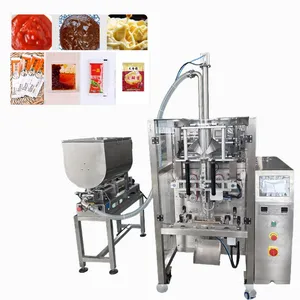
### Vertical Liquid Sachet Machines
Vertical liquid sachet machines are specifically designed for filling and sealing liquid and semi-liquid products into small sachets. Key features include:
- **Precision volumetric or piston filling**: Accurate fill volumes even for products with variable viscosity
- **Clean filling**: Nozzle designs that minimize dripping and splashing, keeping sealing surfaces clean for reliable seals
- **High-speed production**: 30–80 sachets per minute for typical condiment products
- **Flexible sachet sizes**: Adjustable for different portion sizes, from 5 ml to 50 ml
### Applications for Small Producers
Liquid sachet packaging opens up several high-value channels:
- **Food service**: Single-serve condiment packets for restaurants, cafeterias, and catering
- **Retail variety packs**: Assorted sauce samplers that let consumers try multiple flavors
- **Subscription boxes**: Curated sauce collections for monthly delivery services
- **Product sampling**: Low-cost sachets for trade shows, in-store demos, and direct mail campaigns
- **Online sales**: Trial-size sachets that reduce the risk for first-time online customers
The per-sachet cost is typically $0.02–$0.05 for materials, making sachet packaging an extremely cost-effective way to reach new customers and enter new channels.
## Filling Technology: Getting the Right Equipment for Your Viscosity {#section5}
Choosing the right filling technology is critical for sauce and condiment packaging. The wrong choice leads to messy fills, inconsistent weights, and frequent downtime. Here's a guide to matching filling technology to your product:
### Piston Fillers
Best for: Thick sauces (BBQ sauce, ketchup, thick marinades), products with particulates (salsa, relish)
Piston fillers use a reciprocating piston to draw product from a hopper and push it through a filling nozzle. They handle viscous products well and can accommodate chunky products without clogging. Typical accuracy is ±1–2% of target volume.
### Gravity Fillers
Best for: Thin liquids (hot sauce, vinegar-based dressings, thin marinades)
Gravity fillers use the natural flow of liquid from an elevated tank through a filling valve. They're simple, reliable, and well-suited for free-flowing liquids. Accuracy is ±1–2% of target volume.
### Pump Fillers
Best for: Medium-viscosity products (salad dressings, mayonnaise, cream sauces)
Pump fillers use peristaltic or gear pumps to move product through the filling system. They offer good accuracy and are gentle on delicate products.
### Flow Meter Fillers
Best for: High-accuracy applications, products with variable density
Flow meter fillers measure actual product flow using electromagnetic or mass flow meters. They provide the highest accuracy (±0.5%) and are ideal for products with density variations.
For most small sauce and condiment producers, a semi-auto piston filler or pump filler provides the best combination of accuracy, versatility, and cost. These systems typically range from $8,000–$25,000 depending on the number of filling heads and configuration.
## ROI and Operational Benefits for Small Sauce Producers {#section6}
The financial case for semi-automatic packaging in the sauce and condiment industry is compelling:
### Labor Savings
A small sauce producer packaging 15,000 units per month manually typically requires 3–4 operators. Transitioning to a semi-auto pre-made pouch system reduces this to 1–2 operators, saving approximately $30,000–$45,000 annually in labor costs.
### Product Savings
Sauce products are relatively inexpensive per unit, but the volume adds up. At 15,000 units per month with an average product cost of $0.50 per unit:
- Manual overfill of 3%: $2,700/year wasted
- Semi-auto precision filling at 0.5%: $450/year wasted
- **Annual product savings: $2,250**
### Quality Consistency
Semi-automatic packaging eliminates the variability inherent in manual operations. Consistent fill levels, reliable seals, and professional presentation reduce customer complaints, retailer returns, and the hidden costs of inconsistent quality.
### Speed to Market
With semi-auto equipment, small producers can fulfill larger orders faster, respond more quickly to retail opportunities, and take on contracts that would be impossible to meet with manual packaging. This capability often represents the biggest ROI — not the cost savings, but the revenue growth enabled by greater production capacity.
---
### Recommended Equipment
 ## Conclusion
Sauce and condiment packaging requires specialized equipment that can handle the unique challenges of liquid and viscous products — from viscosity variation and corrosion resistance to leak-proof sealing and hygiene compliance. For small producers, semi-automatic equipment — particularly pre-made pouch systems and vertical liquid sachet machines — delivers the professional results needed to compete in this growing market while keeping costs manageable.
The ROI is compelling: reduced labor, less product waste, and the ability to fulfill larger orders translate to payback periods of 12–18 months for most small sauce and condiment operations. But the biggest benefit may be the most intangible: professional, consistent packaging that earns consumer trust and wins retail shelf space.
At SPS Packaging, we work with small sauce and condiment producers to identify the ideal filling and packaging equipment for their specific products. Whether you're packaging thin hot sauces or thick barbecue glazes, our team can help you find the right solution.
**Ready to upgrade your sauce or condiment packaging?** [Request a free quote](/request-quote/) and let our specialists design a packaging solution tailored to your products and production goals.
---
## Related Resources
- [Food Packaging Machines](/food-packaging-machines/) — Browse our complete range of liquid and semi-liquid packaging equipment
- [Labeling Machines](/labeling-machines/) — Add professional labels and nutrition information to your sauce packages
- [Production Lines](/production-lines/) — Design integrated packaging lines for growing condiment operations
- [Solutions by Industry](/solutions/) — Explore packaging solutions tailored to sauces, condiments, and other food sectors
## Conclusion
Sauce and condiment packaging requires specialized equipment that can handle the unique challenges of liquid and viscous products — from viscosity variation and corrosion resistance to leak-proof sealing and hygiene compliance. For small producers, semi-automatic equipment — particularly pre-made pouch systems and vertical liquid sachet machines — delivers the professional results needed to compete in this growing market while keeping costs manageable.
The ROI is compelling: reduced labor, less product waste, and the ability to fulfill larger orders translate to payback periods of 12–18 months for most small sauce and condiment operations. But the biggest benefit may be the most intangible: professional, consistent packaging that earns consumer trust and wins retail shelf space.
At SPS Packaging, we work with small sauce and condiment producers to identify the ideal filling and packaging equipment for their specific products. Whether you're packaging thin hot sauces or thick barbecue glazes, our team can help you find the right solution.
**Ready to upgrade your sauce or condiment packaging?** [Request a free quote](/request-quote/) and let our specialists design a packaging solution tailored to your products and production goals.
---
## Related Resources
- [Food Packaging Machines](/food-packaging-machines/) — Browse our complete range of liquid and semi-liquid packaging equipment
- [Labeling Machines](/labeling-machines/) — Add professional labels and nutrition information to your sauce packages
- [Production Lines](/production-lines/) — Design integrated packaging lines for growing condiment operations
- [Solutions by Industry](/solutions/) — Explore packaging solutions tailored to sauces, condiments, and other food sectors
Pre-Made Pouch Fill & Seal Machine
Perfectly suited for packaging hot sauces, BBQ sauces, marinades, and specialty condiments in premium pre-made pouches with spout caps or resealable zippers.
View Details →
Vertical Liquid Sachet Machine
Designed for filling and sealing liquid and semi-liquid condiments into single-serve sachets with precision filling, clean operation, and consistent seal quality.
View Details →Need Packaging Equipment?
SPS helps small food manufacturers source reliable packaging equipment at factory prices.
Get a Free Quote →