
---
title: "Packaging Machine for Nuts & Seeds: Semi-Auto Solutions for Small Producers"
description: "Explore how small nut and seed producers can boost packaging efficiency with semi-automatic machines that deliver consistent fills, reduce giveaway, and scale affordably."
category: Industry Insights
date: 2026-06-20
tags:
- nut packaging
- seed packaging machine
- small producer equipment
- semi-auto packaging
- food packaging
---
# Packaging Machine for Nuts & Seeds: Semi-Auto Solutions for Small Producers
The American nut and seed market is booming. From almond growers in California to sunflower seed processors in North Dakota, small producers are capitalizing on consumer demand for healthy, protein-rich snacks and ingredients. The U.S. tree nut market alone exceeds $7 billion annually, and the specialty seed market — including hemp hearts, chia, flax, and pumpkin seeds — has seen double-digit growth in recent years.
Yet for small producers, packaging remains a persistent headache. Nuts and seeds present unique challenges: they're lightweight, prone to settling, vary dramatically in shape and size, and often require precise weight control to meet labeling regulations. Hand-packaging works in the earliest stages, but as orders grow, the inefficiencies of manual labor — inconsistent fills, slow throughput, and excessive product giveaway — become real obstacles to profitability.
Semi-automatic packaging equipment offers small nut and seed producers a practical path to professional-grade packaging without the capital outlay of fully industrial systems. This guide covers the key considerations and best equipment options for this growing sector.
## Table of Contents
- [Unique Packaging Challenges in the Nut & Seed Industry](#section1)
- [Packaging Formats That Drive Sales](#section2)
- [Multi-Head Weighing: Precision Filling for Variable Products](#section3)
- [Sachet Solutions for Trail Mix and Single-Serve Portions](#section4)
- [Cost Analysis: Manual vs. Semi-Auto for Nut Packaging](#section5)
- [Scaling Your Packaging Line Strategically](#section6)
## Unique Packaging Challenges in the Nut & Seed Industry {#section1}
Packaging nuts and seeds is deceptively complex. Unlike uniform products like rice or sugar, nut and seed products present several specific challenges that basic packaging equipment often struggles to handle:
### Product Variability
Nut products vary enormously in size, shape, and density. A cashew is nothing like an almond, which is nothing like a sunflower seed. Even within a single product category, size distributions vary based on the growing season, variety, and processing method. This variability makes volumetric filling (which measures by volume rather than weight) unreliable — a cup of large cashews weighs significantly less than a cup of broken pieces.
### Static and Clumping
Small seeds — especially chia, flax, and sesame — are prone to static cling and clumping, which can interfere with clean filling. Nut products with oils (particularly roasted or flavored varieties) can stick to hopper surfaces and filling mechanisms, creating inconsistent fills and difficult cleaning requirements.
### Weight Accuracy Requirements
The FDA and state regulators require that packaged food products meet declared weights. For a 16 oz bag of almonds, the average fill across a production run must meet or exceed 16 oz, with strict limits on how many individual packages can be underfilled. This "reasonable quantity" standard means that imprecise filling forces producers to overfill every bag to stay compliant — and that overfill is pure product giveaway.
For premium nuts at $8–$15 per pound, even 0.5 oz of average overfill per package translates to thousands of dollars in annual waste across a production run of 50,000 units.
### Oxygen and Moisture Sensitivity
Most nuts and seeds are high in unsaturated fats, which are vulnerable to oxidation. Stale or rancid nuts are an immediate quality failure. Packaging must provide excellent oxygen barrier properties, and many producers use nitrogen flushing to displace oxygen before sealing. This requires equipment capable of integrating gas flush operations into the packaging workflow.
## Packaging Formats That Drive Sales {#section2}
The nut and seed industry uses several packaging formats, each suited to different market positions and distribution channels:
### Stand-Up Pouches
Stand-up pouches are the dominant format for retail nut and seed products. They offer good shelf presence, resealable zipper closures, and can be produced in sizes from 1 oz snack packs to 2 lb family sizes. Stand-up pouches work well for:
- Flavored and seasoned nuts
- Trail mix blends
- Raw and roasted nut varieties
- Premium seed products (hemp, chia, pumpkin)
### Flat-Bottom Bags
For premium and specialty positioning, flat-bottom bags provide superior shelf presence and branding opportunities. Their box-like shape allows them to stand upright without support, making them ideal for high-end retail environments and online direct-to-consumer sales.
### Pillow Bags
Pillow bags remain the most economical format for high-volume nut and seed packaging. They're ideal for warehouse club sizes (2–5 lb), food service packs, and value-oriented retail products.
### Sachets and Stick Packs
Single-serve nut and seed packets — for trail mix, portion-controlled snacks, and sample packs — are a growing segment. Sachet and stick pack formats are essential for subscription boxes, hotel amenities, and product sampling programs.
## Multi-Head Weighing: Precision Filling for Variable Products {#section3}
For nut and seed producers, multi-head weighing technology represents the single most impactful packaging upgrade available. Here's why:
### How Multi-Head Weighers Work
A multi-head weigher distributes product across multiple weigh buckets (typically 10–14). A computer algorithm selects the combination of buckets whose combined weight is closest to the target weight. The selected buckets dump their contents into the bag simultaneously, achieving fill accuracy within ±0.5–1 gram of the target.
### Why It Matters for Nuts and Seeds
Traditional volumetric fillers or single-scale fillers struggle with nut products because of their variable density. A multi-head weigher eliminates this problem by weighing actual product rather than estimating by volume. The result:
- **Dramatically reduced giveaway**: Multi-head weighing typically reduces product giveaway from 3–5% (manual or volumetric filling) to 0.5–1%. For a producer packaging 50,000 units of almonds at 1 lb each ($10/lb), reducing giveaway from 4% to 1% saves **$15,000 per year**.
- **Faster throughput**: Multi-head weighers can process 30–120 weigh cycles per minute depending on the product and target weight, far exceeding manual filling speeds.
- **Reduced labor**: One operator can oversee a multi-head weighing and VFFS system that replaces 3–5 manual fillers.
- **Regulatory compliance**: Consistent, documented fill weights simplify compliance with FDA net weight requirements.
### The Combined System
When paired with a vertical form-fill-seal (VFFS) machine, a multi-head weigher creates a complete packaging system: the weigher accurately portions the product, and the VFFS machine forms the bag from a roll of film, fills it, and seals it in one continuous operation. For high-volume producers, this combination is the gold standard for efficiency and accuracy.
## Sachet Solutions for Trail Mix and Single-Serve Portions {#section4}
The single-serve nut and seed market is growing rapidly, driven by consumer demand for portable, portion-controlled snacks. Producing sachets and single-serve packages requires specialized equipment that can handle small fill weights (typically 0.5–2 oz) with precision.
### Vertical Sachet Fill & Seal Machines
Vertical sachet machines form small sachets from a roll of film, fill them with product, and seal them in a continuous vertical operation. Key benefits for nut and seed producers include:
- **High-speed production**: 30–80 sachets per minute for typical nut and seed products
- **Flexible sachet sizes**: Easy adjustment for different portion sizes (0.5 oz, 1 oz, 2 oz)
- **Multiple lane options**: Some machines offer 2–4 lanes for parallel production, multiplying throughput
- **Clean filling**: Designed to handle small, irregular products without spillage
### Applications
Sachet packaging opens up several profitable channels for nut and seed producers:
- **Trail mix variety packs**: Individual sachets of different trail mix combinations
- **Nut butter samples**: Single-serve almond or peanut butter pouches
- **Seed supplements**: Portion-controlled hemp heart, chia, or flax seed packets
- **Gift and promotional packs**: Curated nut and seed samplers for retail and online sales
The per-unit cost of sachet packaging is higher than bulk packaging, but the retail price per ounce is significantly higher — creating attractive margins for producers who can offer single-serve formats.
## Cost Analysis: Manual vs. Semi-Auto for Nut Packaging {#section5}
Understanding the financial impact helps producers make informed equipment decisions. Here's a realistic comparison:
### Scenario: 30,000 Units/Month of Almond Packaging (1 lb bags)
**Manual packaging operation:**
- 4 operators, 6 hours/day: $52,800/year labor
- 4% average product giveaway at $10/lb: $14,400/year
- 2% rejection from inconsistent seals: $7,200/year
- **Total: $74,400/year**
**Semi-auto line (multi-head weigher + VFFS):**
- 1 operator: $23,100/year labor
- 1% product giveaway: $3,600/year
- 0.3% rejection rate: $1,080/year
- Machine depreciation (5 years, $35,000): $7,000/year
- Maintenance and consumables: $3,000/year
- **Total: $37,780/year**
**Annual savings: $36,620** — equipment ROI in approximately 11 months.
These savings compound over time, and they don't account for the revenue growth enabled by faster production, more consistent quality, and the ability to meet larger retail orders.
## Scaling Your Packaging Line Strategically {#section6}
For small nut and seed producers, the smartest approach to equipment investment is phased scaling:
### Phase 1: Semi-Auto Sachet Machine
Start with a vertical sachet fill and seal machine if single-serve products are your primary growth opportunity. This investment (typically $15,000–$30,000) opens up subscription box, sampling, and food service channels with minimal labor.
### Phase 2: Multi-Head Weigher + VFFS
As your retail bag volume grows beyond 10,000 units/month, add a multi-head weigher paired with a VFFS system. This combination handles the bulk of your retail packaging with precision and speed.
### Phase 3: Integrated Line
Add checkweighers, date coders, conveyors, and case packers to create a semi-automated line that approaches fully automated performance at a fraction of the cost.
### Key Planning Considerations
- **Floor space**: Plan for 15–25 feet of linear space for a complete semi-auto line
- **Electrical requirements**: Most semi-auto machines require 220V/3-phase power
- **Compressed air**: Many packaging machines need 80–100 PSI compressed air
- **Cleaning access**: Leave adequate space around machines for cleaning and maintenance
- **Product flow**: Design your layout so product moves in one direction — from bulk storage through filling to finished goods
---
### Recommended Equipment
 ## Conclusion
Nuts and seeds are among the most packaging-intensive food products, requiring precision filling, oxygen barrier protection, and consistent presentation. For small producers, semi-automatic equipment — particularly multi-head weighers paired with VFFS systems and vertical sachet machines — delivers the accuracy, speed, and versatility needed to compete in this fast-growing market.
The ROI is compelling: most small nut and seed producers see full equipment payback within 12 months through labor savings and reduced product giveaway alone. And as your production grows, semi-auto equipment can be expanded into complete packaging lines that approach fully automated performance.
At SPS Packaging, we help small nut and seed producers identify the right equipment for their products, volumes, and growth plans. Our team provides hands-on consultation to ensure your packaging investment delivers maximum return.
**Ready to automate your nut and seed packaging?** [Request a free quote](/request-quote/) and discover how semi-automatic equipment can transform your operation.
---
## Related Resources
- [Food Packaging Machines](/food-packaging-machines/) — Browse our complete range of food packaging equipment for nuts, seeds, and beyond
- [Labeling Machines](/labeling-machines/) — Add nutrition facts, branding, and compliance labels to your packages
- [Production Lines](/production-lines/) — Design integrated packaging lines for growing nut and seed operations
- [Solutions by Industry](/solutions/) — Explore packaging solutions tailored to specific food industry sectors
## Conclusion
Nuts and seeds are among the most packaging-intensive food products, requiring precision filling, oxygen barrier protection, and consistent presentation. For small producers, semi-automatic equipment — particularly multi-head weighers paired with VFFS systems and vertical sachet machines — delivers the accuracy, speed, and versatility needed to compete in this fast-growing market.
The ROI is compelling: most small nut and seed producers see full equipment payback within 12 months through labor savings and reduced product giveaway alone. And as your production grows, semi-auto equipment can be expanded into complete packaging lines that approach fully automated performance.
At SPS Packaging, we help small nut and seed producers identify the right equipment for their products, volumes, and growth plans. Our team provides hands-on consultation to ensure your packaging investment delivers maximum return.
**Ready to automate your nut and seed packaging?** [Request a free quote](/request-quote/) and discover how semi-automatic equipment can transform your operation.
---
## Related Resources
- [Food Packaging Machines](/food-packaging-machines/) — Browse our complete range of food packaging equipment for nuts, seeds, and beyond
- [Labeling Machines](/labeling-machines/) — Add nutrition facts, branding, and compliance labels to your packages
- [Production Lines](/production-lines/) — Design integrated packaging lines for growing nut and seed operations
- [Solutions by Industry](/solutions/) — Explore packaging solutions tailored to specific food industry sectors
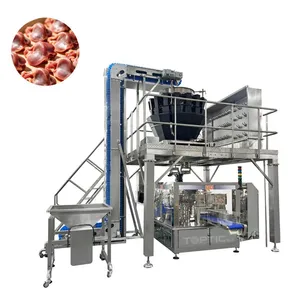
Multi-Head Weigher + VFFS System
Delivers precision filling for nuts, seeds, and trail mix with ±1g accuracy, dramatically reducing product giveaway while maximizing throughput on your packaging line.
View Details →
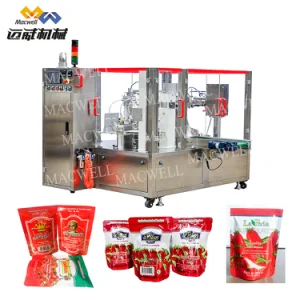
Vertical Sachet Fill & Seal Machine
Ideal for producing single-serve nut packs, trail mix sachets, and seed portion packets with precise filling and consistent, retail-quality seals.
View Details →Need Packaging Equipment?
SPS helps small food manufacturers source reliable packaging equipment at factory prices.
Get a Free Quote →