
# Multi-Head Weigher Selection Guide: Finding the Perfect Fit
If you've ever watched a multi-head weigher in action, you know there's a certain magic to it. A dozen small buckets flash open and close in rapid combinations, each cycle precisely measuring the target weight. The result: bag after bag of perfectly portioned product, with giveaway measured in fractions of a gram rather than multiple grams.
The technology has become the gold standard for weighing free-flowing food products in mid to high-volume packaging operations. Snack foods, candy, frozen vegetables, coffee, nuts, pet food, and frozen prepared foods all use multi-head weighers as the standard weighing solution.
But not all multi-head weighers are created equal. Choosing the right one for your product, your volume, and your packaging line makes the difference between a weigher that delivers precision for 15 years and one that frustrates your operators and falls short of its accuracy claims. This guide walks you through the selection process step by step.
## Table of Contents
1. [What Is a Multi-Head Weigher and Why It Matters](#section1)
2. [Understanding the Key Specifications](#section2)
3. [Matching Weigher Configuration to Your Product](#section3)
4. [Speed, Accuracy, and the Real-World Trade-off](#section4)
5. [Construction Materials and Sanitation Design](#section5)
6. [Integration with VFFS Machines and Conveyors](#section6)
7. [Total Cost of Ownership](#section7)
8. [Common Selection Mistakes](#section8)
9. [Conclusion](#conclusion)
---
## 1. What Is a Multi-Head Weigher and Why It Matters {#section1}
A [multi-head weigher](/food-packaging-machines/multihead-weighers/) is a precision weighing system that combines multiple small portions of product to achieve a target weight with high accuracy. The weigher consists of a circular array of weigh buckets (typically 10, 14, or 16 buckets in most food applications), each with its own load cell. Product is fed into the top of the weigher through a distribution cone, then flows into a top ring of buckets. The weigher's computer rapidly computes all possible combinations of buckets that sum to the target weight, selects the combination with the smallest total deviation, and discharges that combination into a waiting package.
The result is dramatically better accuracy than volumetric or single-bucket weighing systems. While a volumetric cup filler might achieve ±2–5% accuracy on irregular products, a multi-head weigher routinely achieves ±0.1–0.3% accuracy. For a 100-gram target weight, that's a difference between ±2–5 grams and ±0.1–0.3 grams. Over millions of packages, that accuracy translates to enormous savings in product giveaway.
The technology is particularly well-suited to free-flowing products with consistent piece or particle size. Snack foods, candy, frozen vegetables, nuts, and coffee all work exceptionally well on multi-head weighers. The technology struggles with very sticky products, very large products, and products that clump or bridge. For those challenging products, alternative weighing technologies may be more appropriate.
---
## 2. Understanding the Key Specifications {#section2}
When comparing multi-head weighers, several specifications matter more than others. Understanding what each specification means — and what range is appropriate for your application — is essential for making a confident selection.
**Number of weigh heads.** More heads means more combinations, which means higher accuracy at high speed. A 10-head weigher can run at 60–80 weighings per minute. A 14-head weigher runs at 80–100 weighings per minute. A 16-head weigher runs at 100–120 weighings per minute. The extra heads also improve accuracy — the more combinations available, the closer the weigher can get to the target weight on each cycle.
**Maximum weighing speed.** Specified in weighings per minute (WPM) or bags per minute (BPM). The maximum speed is only achievable with perfect product flow, optimal settings, and consistent product characteristics. Real-world speed is typically 60–75% of maximum. For accurate capacity planning, use the real-world figure.
**Weighing range.** The range of weights the weigher can accurately handle. Standard models cover 10g to 1,000g. High-range models extend to 3,000g or more. Choose a weigher whose range comfortably covers your target weights, with margin for product variations and seasonal adjustments.
**Accuracy specification.** Usually expressed as a multiple of the standard deviation (e.g., "2 sigma accuracy of ±0.5g" means 95% of weighings fall within ±0.5g of target). Better accuracy specifications typically come from more weigh heads and tighter load cell tolerances.
**Construction materials.** Look for stainless steel construction in all product contact zones, food-grade plastics for product contact components, and IP65 or higher rated electrical enclosures. Avoid machines with painted surfaces or non-food-grade materials in product zones.
**Control system.** Modern multi-head weighers use touchscreen interfaces for operator control, recipe storage, and diagnostics. Verify the interface is intuitive (typically available in multiple languages) and that the system can store a large number of product recipes for easy changeover.
**Power and air requirements.** Standard multi-head weighers typically require 220V or 380V three-phase power and 0.5–0.8 MPa compressed air. Verify your facility can supply both before finalizing your selection.
---
## 3. Matching Weigher Configuration to Your Product {#section3}
Different products place different demands on a multi-head weigher. The configuration that works perfectly for potato chips will frustrate you if you try to run it with frozen chicken nuggets. Here's how to think about configuration matching:
**Free-flowing granular products (rice, candy, small nuts, coffee beans, frozen peas)** are the easiest products for multi-head weighers. Standard configurations with smooth buckets work well. Choose a 10-head or 14-head model based on your speed requirements. Bucket volume should be appropriate for your target weight — typically 1.5x to 2.5x your largest target weight for optimal accuracy.
**Irregularly shaped products (tortilla chips, dried fruit, irregular candy, jerky)** require gentle handling. Look for weighers with wider bucket openings, smooth bucket surfaces, and adjustable product flow controls. Bucket volume should be on the larger side to accommodate the irregular shapes without misfeeding.
**Sticky products (gummy candy, dried fruit clusters, granola clusters, caramel)** are challenging. The product tends to clump and stick to bucket surfaces. Look for weighers with non-stick bucket coatings, special anti-bridging devices, and bucket designs that promote complete discharge. Heated buckets are sometimes used for particularly sticky products.
**High-density products (nuts, candy, granola, pet food kibble)** weigh more per unit volume, which means smaller target weights are easier to achieve. Standard configurations work well, but verify the load cell capacity is appropriate for the expected bucket weights.
**Fragile products (tortilla chips, certain snack crackers, delicate candy)** require gentle handling throughout. Look for weighers with reduced drop heights, cushioned bucket surfaces, and slow-flow discharge options. A 10-head weigher with smooth buckets is often better for fragile products than a higher-head weigher that requires faster cycling.
**High-fat or oily products (roasted nuts, fried snacks)** can build up residue on bucket surfaces. Look for weighers with easy-to-clean bucket designs, accessible surfaces for wipe-down, and food-grade non-stick coatings on the most exposed surfaces.
---
## 4. Speed, Accuracy, and the Real-World Trade-off {#section4}
The relationship between speed and accuracy in multi-head weighing is fundamentally a trade-off. Higher cycle speeds give you more combinations per minute but limit the time available for each combination calculation. Slower speeds allow more careful calculation and higher accuracy, but reduce throughput.
Most modern multi-head weighers handle this trade-off through software algorithms that prioritize accuracy at lower speeds and throughput at higher speeds. You can typically adjust the "accuracy threshold" — the weigher will only discharge when a combination falls within the specified accuracy window. Setting a tighter threshold improves accuracy but reduces speed.
For most small food manufacturers, the practical implication is this: the speed claimed in the product brochure is the maximum achievable with the loosest accuracy setting. If you tighten the accuracy threshold to meet your product specifications, the effective speed drops by 20–40%. This is normal and expected.
The right way to think about speed and accuracy: determine your target weight, your acceptable accuracy window (typically ±1% of target for retail products), and your required throughput. Then choose a weigher that can deliver that throughput at the required accuracy. The number of weigh heads is the primary determinant — more heads means more combinations per cycle, which means you can maintain higher speeds at tighter accuracy thresholds.
**Rule of thumb:** For most small food manufacturers producing 30,000 to 100,000 bags per month, a 10-head or 14-head weigher is the right starting point. A 16-head weigher makes sense when you're producing 100,000+ bags per month and need to maintain tight accuracy at higher speeds.
---
## 5. Construction Materials and Sanitation Design {#section5}
Food safety regulations require equipment to be designed for cleanability. For multi-head weighers, this means every product contact surface must be accessible, smooth, and made from materials that withstand repeated cleaning.
**Stainless steel grade** is the first consideration. 304 stainless steel is the industry standard for food contact surfaces in most food applications. For products with high salt content, high acid content, or exposure to harsh sanitizers, 316 stainless steel provides additional corrosion resistance. The weigher's frame, distribution cone, and main structural components are typically 304 stainless.
**Bucket surface finish** affects both product release and cleanability. Highly polished bucket surfaces release product more easily (improving accuracy) and are easier to clean. Matte or rough surfaces trap product and are harder to sanitize. Specify polished stainless buckets for most food applications.
**Bucket design** affects how well the weigher handles your specific product. Smooth cylindrical buckets work well for free-flowing granular products. Buckets with stepped or ridged interiors help with sticky products. Buckets with non-stick coatings are useful for very sticky applications. Many manufacturers offer multiple bucket styles that can be swapped to optimize for different products.
**Access for cleaning** is critical. The bucket ring should be easily removable for hand-cleaning or washing. The distribution cone should be accessible without tools. The load cells and electronics should be sealed against moisture and food ingress (typically IP65 or higher rating). Drain holes should be present in all sumps and bases to prevent water pooling.
**Sanitation certification** can provide third-party validation. Look for weigher manufacturers whose equipment is NSF certified for food zone applications, or who can provide documentation of compliance with 3-A sanitary standards. These certifications are not legally required for all food equipment, but they signal that the manufacturer has designed the equipment with food safety in mind.
---
## 6. Integration with VFFS Machines and Conveyors {#section6}
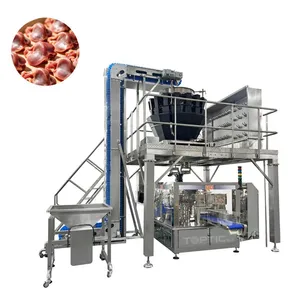
A multi-head weigher rarely operates in isolation. It almost always pairs with a VFFS machine, a conveyor system, and often a checkweigher and metal detector. The mechanical and electrical integration between these components is critical for line reliability and accuracy.
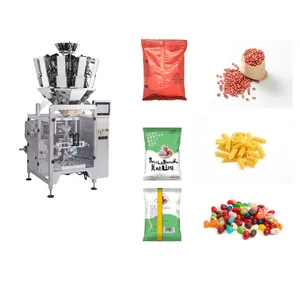
**Mechanical integration** includes the discharge chute that connects the weigher to the VFFS forming tube, the support structure that holds both machines at the proper height, and the product transfer that minimizes spillage and breakage. A [multi-head weigher + VFFS system](/food-packaging-machines/multihead-weighers/multi-head-weigher-vffs-system/) from a single manufacturer typically includes pre-engineered integration hardware, which simplifies installation and reduces compatibility risk.
**Electrical integration** allows the weigher and VFFS to communicate — the weigher signals when product is discharged, the VFFS opens the bag at the right moment, the sealing cycle begins, and the bag is released downstream. Most modern systems use simple digital I/O for this communication, with the specific signaling defined during installation. Verify that the weigher's I/O configuration is compatible with your VFFS machine before purchasing.
**Conveyor integration** moves finished packages to the next station. For most operations, a simple outfeed conveyor is sufficient. For more complex lines, you may need a checkweigher conveyor, a metal detector conveyor, and accumulation conveyors between stations. Plan for the conveyor equipment in your budget and facility layout from the start.
**Timing and synchronization** is often the most challenging aspect of integration. The weigher cycle, the VFFS bag-forming cycle, and the sealing cycle must all be synchronized for smooth operation. Modern machines handle this automatically through their control systems, but the initial setup typically requires 1–3 days of commissioning work by a qualified technician.
**Line height and clearance** are practical concerns. A multi-head weigher plus VFFS system typically requires 8–10 feet of ceiling height and a footprint of 8–12 feet long by 4–5 feet wide. Plan your facility layout accordingly. If ceiling height is constrained, low-profile models are available from some manufacturers.
---
## 7. Total Cost of Ownership {#section7}
The sticker price of a multi-head weigher is just the starting point for total cost. Smart buyers evaluate the full cost picture over the equipment's expected life (typically 10–15 years for a quality weigher).
**Purchase price** ranges from $20,000 to $60,000 for a new 10 to 16-head weigher, depending on features and construction. Premium models from top manufacturers can exceed $100,000. Used and refurbished weighers in good condition are available for $8,000 to $25,000.
**Installation and commissioning** typically adds $3,000 to $10,000 to the total cost, including mechanical installation, electrical hookup, and initial calibration. Complex integrated systems can exceed $20,000 in installation costs.
**Maintenance costs** for a multi-head weigher run 5–8% of the purchase price annually in normal use. The main maintenance items are load cell replacement (every 5–10 years for one or more cells), bucket replacement (every 3–7 years depending on product abrasiveness), and electronics maintenance. Budget $1,500 to $5,000 per year for routine maintenance.
**Spare parts inventory** should include commonly replaced items: load cells, bucket assemblies, drive belts, and control system components. Initial spare parts budget of $2,000 to $5,000 is appropriate for a typical weigher.
**Operating consumables** include lubricants, cleaning supplies, and calibration weights. These costs are small individually but add up to $500 to $2,000 per year.
**Energy and air consumption** is a minor but ongoing cost. A typical multi-head weigher uses 1–2 kW of power and 50–100 liters per minute of compressed air. The annual cost of energy and air for these consumptions is typically $500 to $1,500.
**Total 10-year cost of ownership** for a $40,000 weigher, including all the costs above, typically runs $90,000 to $120,000 — about 2.5x to 3x the initial purchase price. This is the figure to use when comparing different weigher options or evaluating the weigher against alternative technologies.
---
## 8. Common Selection Mistakes {#section8}
After helping hundreds of small food manufacturers select multi-head weighers, certain mistakes come up again and again. Here's how to avoid them:
**Mistake 1: Buying too many weigh heads for your volume.** A 16-head weigher is a wonderful machine, but if your line is only running 20 bags per minute, a 10-head weigher will deliver the same accuracy at lower cost. Match the weigher to your actual production requirements.
**Mistake 2: Ignoring product characteristics.** The most expensive weigher in the world won't deliver good results if its bucket design is wrong for your product. Always request product testing before purchasing, or at minimum detailed discussions with the manufacturer's application engineers.
**Mistake 3: Underestimating integration complexity.** A standalone weigher is one thing; an integrated weigher-VFFS-conveyor-checkweigher system is another. Budget for integration time, integration costs, and integration risk.
**Mistake 4: Focusing on price over total cost.** The cheapest weigher is rarely the lowest total cost. A higher-quality weigher with better accuracy will pay for itself through reduced giveaway, often within the first year of operation.
**Mistake 5: Skipping the on-site demo or product test.** A weigher that performs beautifully in the manufacturer's test lab with uniform plastic pellets may perform poorly with your actual product. Always request a product test with your specific product before purchasing.
**Mistake 6: Forgetting about operator training.** Even the best weigher is only as good as its operator. Plan for comprehensive training during commissioning and follow-up training as you bring on new operators.
---
---
### Recommended Equipment
 ---
### Recommended Equipment
---
### Recommended Equipment
 ## Conclusion {#conclusion}
Selecting the right [multi-head weigher](/food-packaging-machines/multihead-weighers/) is one of the most impactful equipment decisions a small food manufacturer can make. The accuracy gains over volumetric or single-bucket weighing translate directly to product cost savings, often paying for the weigher within the first year of operation. The right weigher for your operation depends on your product characteristics, your production volume, your accuracy requirements, and your integration plan.
Start by matching the weigher configuration to your product, determine the number of weigh heads based on your speed and accuracy requirements, evaluate the construction and sanitation design for food safety, and plan for the full total cost of ownership over the equipment's life. With this framework, you can confidently select a weigher that will deliver precision and reliability for years to come.
**Need help selecting the right multi-head weigher for your product?** SPS carries a range of multi-head weigher configurations and VFFS integration systems, and our team can help you evaluate the right starting point for your operation. [Request a quote](/request-quote/) and our application engineers will guide you through the selection process.
---
## Related Products
- [Labeling Machines](/labeling-machines/) — Automated labeling systems for weighed packages
- [Complete Production Lines](/production-lines/) — Integrated weighing and packaging lines
- [Multi-Head Weigher + VFFS System](/food-packaging-machines/multihead-weighers/multi-head-weigher-vffs-system/) — Pre-engineered combination for turnkey installation
- [Automatic FFS Packaging Machine](/food-packaging-machines/ffs-machines/automatic-ffs-packaging-machine/) — Compatible VFFS machine for high-speed snack packaging
- [Snack Packaging Solutions](/solutions/snacks/) — Complete configurations for snack manufacturers
## Conclusion {#conclusion}
Selecting the right [multi-head weigher](/food-packaging-machines/multihead-weighers/) is one of the most impactful equipment decisions a small food manufacturer can make. The accuracy gains over volumetric or single-bucket weighing translate directly to product cost savings, often paying for the weigher within the first year of operation. The right weigher for your operation depends on your product characteristics, your production volume, your accuracy requirements, and your integration plan.
Start by matching the weigher configuration to your product, determine the number of weigh heads based on your speed and accuracy requirements, evaluate the construction and sanitation design for food safety, and plan for the full total cost of ownership over the equipment's life. With this framework, you can confidently select a weigher that will deliver precision and reliability for years to come.
**Need help selecting the right multi-head weigher for your product?** SPS carries a range of multi-head weigher configurations and VFFS integration systems, and our team can help you evaluate the right starting point for your operation. [Request a quote](/request-quote/) and our application engineers will guide you through the selection process.
---
## Related Products
- [Labeling Machines](/labeling-machines/) — Automated labeling systems for weighed packages
- [Complete Production Lines](/production-lines/) — Integrated weighing and packaging lines
- [Multi-Head Weigher + VFFS System](/food-packaging-machines/multihead-weighers/multi-head-weigher-vffs-system/) — Pre-engineered combination for turnkey installation
- [Automatic FFS Packaging Machine](/food-packaging-machines/ffs-machines/automatic-ffs-packaging-machine/) — Compatible VFFS machine for high-speed snack packaging
- [Snack Packaging Solutions](/solutions/snacks/) — Complete configurations for snack manufacturers
Multi-Head Weigher + VFFS System
10-head weigher + VFFS combo — the sweet spot for 30–60 bags/min production.
View Details →
Vertical Form Fill Seal Machine
Pair any multi-head weigher with a VFFS for a complete weigh-fill-seal system.
View Details →Need Packaging Equipment?
SPS helps small food manufacturers source reliable packaging equipment at factory prices.
Get a Free Quote →