
---
title: "Packaging Machine for Meat & Poultry Processing"
date: 2025-06-20
description: "Learn how meat and poultry processors can automate tray sealing and packaging. Covers MAP technology, food safety compliance, and ROI analysis for small to mid-size operations."
category: "Industry Insights"
author: "SPS Packaging Team"
---
# Packaging Machine for Meat & Poultry Processing
Meat and poultry packaging isn't just about containment—it's about food safety. Every sealed tray of chicken breast or package of ground beef must maintain an airtight seal that prevents contamination, controls atmosphere, and keeps the product fresh from processing plant to consumer's refrigerator. When packaging fails, the consequences aren't just financial—they're public health risks.
The USDA estimates that foodborne illness outbreaks cost the U.S. economy $15.6 billion annually. For individual processors, a single recall can cost $10 million or more in direct expenses—not counting the brand damage that lingers for years. Proper packaging technology is the first line of defense.
Yet many small and mid-size meat and poultry processors still rely on outdated packaging methods: manual tray sealing with inconsistent seals, hand-applied labels, and packaging lines that can't keep up with production. In an industry where every second of exposure to ambient air is a safety risk, this approach is both dangerous and inefficient.
Modern tray sealing and MAP packaging technology offers a path to safer, faster, and more cost-effective packaging—even for operations that aren't ready for a fully automated production line.
## Table of Contents
- [The Critical Role of Packaging in Meat & Poultry Safety](#section1)
- [MAP Technology for Extended Meat Shelf Life](#section2)
- [Tray Sealing for Meat & Poultry: What You Need to Know](#section3)
- [Food Safety Compliance and Packaging](#section4)
- [ROI Analysis: Automated Meat Packaging](#section5)
- [Building a Packaging Line for Meat & Poultry](#section6)
## The Critical Role of Packaging in Meat & Poultry Safety {#section1}
Meat and poultry are among the most perishable food products in the supply chain. Fresh chicken has a shelf life of 1–2 days in ambient conditions. Ground beef is similarly short. The packaging must:
**Prevent microbial contamination.** An imperfect seal allows bacteria—Listeria, Salmonella, E. coli—to enter the package. MAP technology reduces oxygen levels to inhibit aerobic bacterial growth, extending safe shelf life.
**Maintain cold chain integrity.** Packaging must withstand temperatures from 40°F (display case) to -18°F (frozen storage) without seal failure. Temperature cycling during distribution creates condensation that tests seal quality.
**Control moisture and drip.** Meat packaging must contain purge (the liquid that naturally exudes from fresh meat) while maintaining an attractive presentation. Leaking trays are both a safety hazard and a consumer complaint.
**Support traceability.** USDA and FSIS requirements mandate lot coding, production dating, and plant identification on all meat and poultry packaging. Your packaging line must integrate with date coding and labeling systems.
According to the American Meat Institute, 98% of meat recalls are linked to packaging or handling issues rather than processing defects. Investing in reliable, consistent packaging technology is the most direct way to reduce your recall risk.
## MAP Technology for Extended Meat Shelf Life {#section2}
Modified Atmosphere Packaging (MAP) is the industry standard for fresh meat and poultry. By replacing the oxygen in a package with a controlled gas mixture, MAP significantly extends shelf life while maintaining product appearance and safety.
**Typical MAP gas mixtures for meat:**
| Product | O₂ | CO₂ | N₂ | Shelf Life Extension |
|---------|-----|------|-----|---------------------|
| Red meat (steaks, roasts) | 70–80% | 20–30% | 0–10% | 7–14 days (vs. 2–3 days) |
| Poultry (fresh) | 0–2% | 25–30% | 70–75% | 9–12 days (vs. 1–2 days) |
| Ground meat | 0–2% | 25–30% | 70–75% | 5–7 days (vs. 1–2 days) |
| Sliced deli meats | 0–2% | 25–30% | 70–75% | 21–30 days (vs. 5–7 days) |
The high-oxygen atmosphere for red meat keeps myoglobin in its bright red oxymyoglobin form—that appealing "fresh" color consumers associate with quality. For poultry, the low-oxygen, high-CO₂ atmosphere suppresses spoilage organisms and extends shelf life without the color considerations of red meat.
MAP is not optional for modern meat packaging—it's expected by retailers and consumers. A fresh meat tray without MAP will be rejected by virtually every major grocery retailer in the United States.
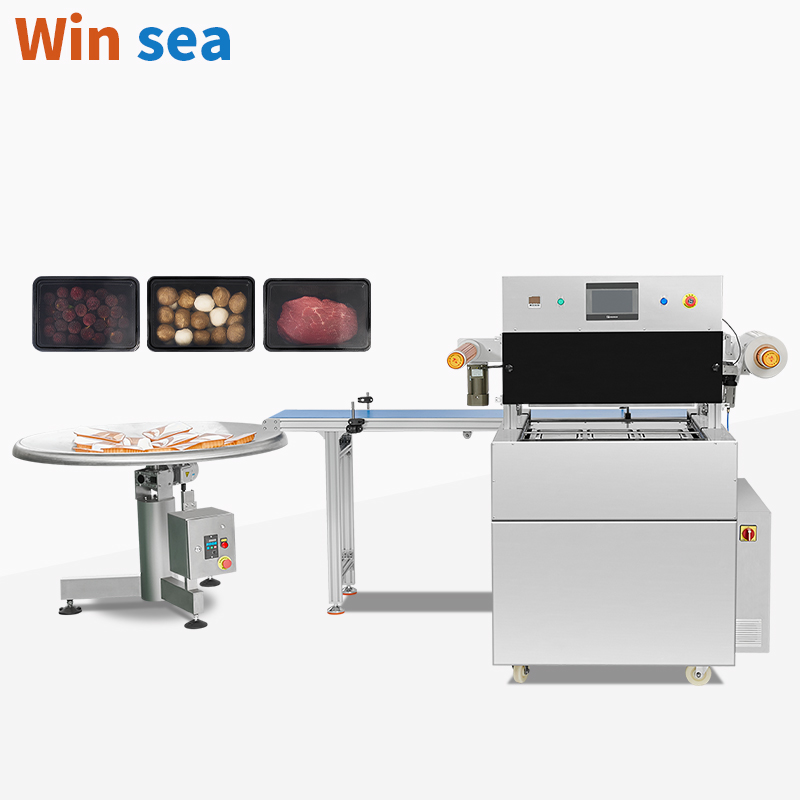
The Automatic Multi-Function Meat Food Tray Sealer is purpose-built for meat and poultry MAP packaging. It handles multiple tray sizes, performs precision gas flushing, and delivers the consistent seal quality that food safety auditors require.
## Tray Sealing for Meat & Poultry: What You Need to Know {#section3}
Tray sealing is the most common packaging format for retail meat and poultry. Understanding the technology helps you make informed equipment decisions:
**Seal types:**
- **Heat seal:** The most common method. A heated bar presses the film against the tray flange, creating a hermetic seal. Modern machines control temperature, pressure, and dwell time independently for optimal results across tray and film combinations.
- **Skin pack:** A premium format where the top film conforms tightly to the product surface, eliminating headspace and purge movement. Increasingly popular for premium cuts and steaks.
- **Lidding:** A simpler application where film is applied over the tray without gas flushing. Suitable for frozen products and cooked items.
**Tray materials:**
- **PET:** The most common. Recyclable, good clarity, and suitable for MAP applications
- **PP (Polypropylene):** Microwaveable. Used for ready-to-cook and ready-to-eat products
- **rPET:** Recycled PET. Increasingly required by retailers pursuing sustainability goals
- **Foam PS:** Traditional and low-cost, but facing sustainability pressure. Being phased out by many retailers
**Critical seal parameters for meat:**
- Seal temperature: 120–180°C depending on film and tray material
- Seal pressure: 2–4 bar (must be uniform across the entire seal area)
- Dwell time: 0.5–2 seconds
- Gas composition accuracy: ±2% for reliable shelf life extension
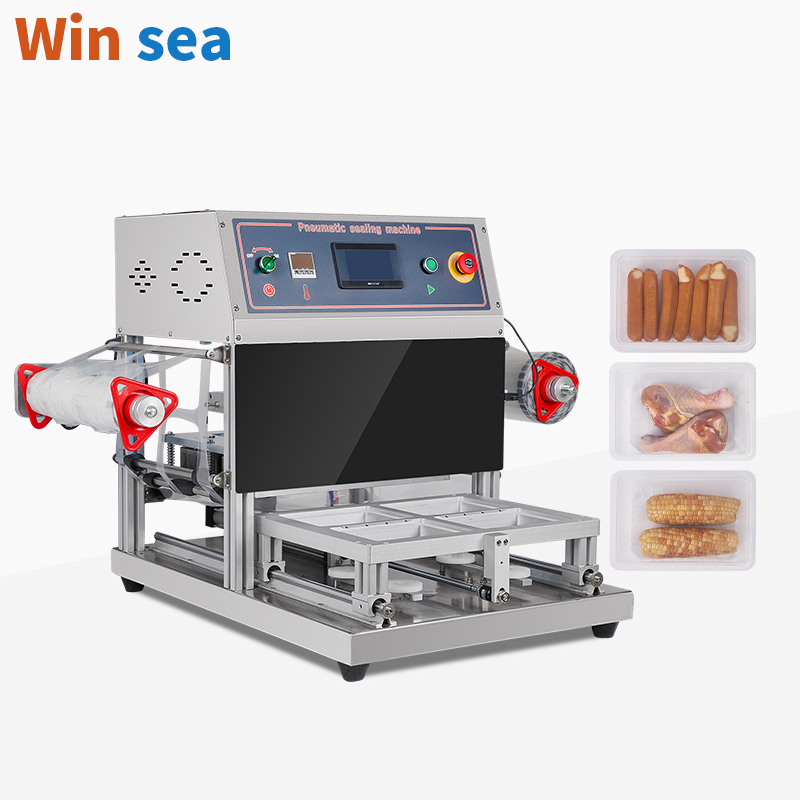
The Food Tray Sealer Machine handles standard meat trays with MAP capability, offering a semi-automatic solution that delivers consistent seal quality without the footprint or cost of a fully automated line.
## Food Safety Compliance and Packaging {#section4}
Meat and poultry packaging must comply with a web of federal, state, and industry requirements. Your packaging equipment directly impacts your ability to pass audits:
**USDA/FSIS requirements:**
- Product labeling with net weight, ingredients, allergens, and plant number
- Lot coding for traceability (typically Julian date + shift + line number)
- Date marking (use-by or sell-by dates based on validated shelf life)
- Packaging must maintain product integrity through the labeled shelf life
**SQF/BRC certification requirements:**
- Equipment construction: Stainless steel (304 or 316), food-grade contact surfaces
- Cleanability: No harborage points, smooth welds, tool-free disassembly for cleaning
- Calibration: Gas analyzers and seal testers must be calibrated per documented procedures
- Documentation: Packaging parameters (temperature, pressure, gas composition) must be recorded and retained
**Retailer vendor manuals:**
- Major retailers (Walmart, Kroger, Costco) have specific packaging specifications
- Seal strength testing (burst testing, vacuum decay testing) required for new packaging formats
- Label placement specifications measured in millimeters
A well-designed tray sealer simplifies compliance. Features like automatic seal quality monitoring, integrated gas analysis, and data logging reduce the documentation burden on your QA team while ensuring consistent results that satisfy auditors.
## ROI Analysis: Automated Meat Packaging {#section5}
For a small poultry processor packing 8,000 units per week:
**Current manual tray sealing:**
- 3 workers × 8 hours × $16/hour × 6 days = $2,304/week in packaging labor
- Seal failure rate: 5–8% → rework and waste costs: $800/week
- Shelf life: limited by inconsistent MAP → higher shrink at retail: $1,200/week
- **Total weekly packaging-related cost: $4,304**
**Semi-automatic tray sealer with MAP:**
- 1 worker × 6 hours × $16/hour × 6 days = $576/week in packaging labor
- Seal failure rate: <1% → rework costs: $80/week
- Shelf life extended by 3x → retail shrink reduced: $400/week
- Machine amortization (5 years on $90,000): $346/week
- Gas costs: $120/week
- **Total weekly packaging-related cost: $1,522**
**Annual savings: $144,848**
**Payback period: approximately 8 months**
The shelf life extension alone often justifies the investment. If MAP packaging allows a processor to ship products further (expanding distribution radius), the revenue opportunity can multiply these savings several times over.
For frozen meat and poultry, the equation shifts: MAP is less critical, but seal integrity at freezing temperatures is paramount. A machine that delivers consistent, hermetic seals at sub-zero temperatures virtually eliminates freezer burn—the number one cause of frozen meat returns and consumer complaints.
## Building a Packaging Line for Meat & Poultry {#section6}
A complete meat and poultry packaging line typically includes these components:
**1. Tray denesting.** Automatic tray denesters separate nested trays and place them on the conveyor. For operations packing 5,000+ units per week, manual tray placement becomes a bottleneck.
**2. Filling and portioning.** Multi-head weighers or volumetric fillers ensure accurate portions. Overfilling by just 3% on a $5/lb product costs $0.15 per package—$7,800 annually at 1,000 packages per day.
**3. Tray sealing with MAP.** The core of the line. Select a machine based on your throughput needs, tray sizes, and MAP requirements.
**4. Date coding.** Inkjet or thermal transfer printers apply lot codes, production dates, and use-by dates directly on the package or label.
**5. Labeling.** Automatic or semi-automatic labeling for front labels, nutrition facts, and compliance information.
**6. Case packing.** For shipping to retail distribution centers, cases are packed and sealed for palletization.
You don't need to automate every step at once. Most small processors start with a tray sealer and add components as volume grows. The key is choosing equipment that integrates with future additions—a modular approach that grows with your business.
---
### Recommended Equipment
 ## Conclusion
Meat and poultry packaging is a matter of food safety, regulatory compliance, and consumer trust. Modern tray sealing technology with MAP capability delivers the consistent, hermetic seals that protect product integrity—and your brand. For small and mid-size processors, the ROI is compelling: labor savings, reduced waste, extended shelf life, and a packaging line that grows with your business.
Ready to upgrade your meat and poultry packaging? [Request a quote](/request-quote/) and our specialists will recommend the right tray sealer for your products, throughput, and compliance requirements.
---
## Related Resources
- [Food Packaging Machines](/food-packaging-machines/) — Complete catalog of food packaging equipment
- [Labeling Machines](/labeling-machines/) — Labeling solutions for meat, poultry, and deli products
- [Production Lines](/production-lines/) — End-to-end packaging line design for protein processors
- [Solutions](/solutions/) — Custom packaging solutions for meat and poultry
## Conclusion
Meat and poultry packaging is a matter of food safety, regulatory compliance, and consumer trust. Modern tray sealing technology with MAP capability delivers the consistent, hermetic seals that protect product integrity—and your brand. For small and mid-size processors, the ROI is compelling: labor savings, reduced waste, extended shelf life, and a packaging line that grows with your business.
Ready to upgrade your meat and poultry packaging? [Request a quote](/request-quote/) and our specialists will recommend the right tray sealer for your products, throughput, and compliance requirements.
---
## Related Resources
- [Food Packaging Machines](/food-packaging-machines/) — Complete catalog of food packaging equipment
- [Labeling Machines](/labeling-machines/) — Labeling solutions for meat, poultry, and deli products
- [Production Lines](/production-lines/) — End-to-end packaging line design for protein processors
- [Solutions](/solutions/) — Custom packaging solutions for meat and poultry
Automatic Multi-Function Meat Food Tray Sealer
Purpose-built for meat and poultry—pneumatic MAP tray sealing with multi-format capability for fresh and frozen protein packaging.
View Details →
Food Tray Sealer Machine
Versatile automatic tray sealer with MAP capability—ideal for processors needing reliable seals across multiple tray sizes and products.
View Details →Need Packaging Equipment?
SPS helps small food manufacturers source reliable packaging equipment at factory prices.
Get a Free Quote →