
---
title: "Packaging Machine for Fresh Produce & Frozen Foods"
date: 2025-06-20
description: "Discover the best packaging machines for fresh produce and frozen food operations. Learn how MAP and tray sealing technology extends shelf life and reduces shrink for small food producers."
category: "Industry Insights"
author: "SPS Packaging Team"
---
# Packaging Machine for Fresh Produce & Frozen Foods
Fresh produce and frozen food producers face a paradox: consumers demand longer shelf life and pristine presentation, yet the product itself is inherently perishable and sensitive to handling. Every hour a package sits in a warehouse or on a retail shelf, the clock is ticking. In the United States, food retailers report an average shrink rate of 5–10% for fresh produce—meaning that for every $100 of product, $5 to $10 is lost to spoilage before it ever reaches the consumer. For frozen foods, improper packaging leads to freezer burn, texture degradation, and brand-damaging returns.
The solution isn't simply better packaging materials. It's smarter packaging automation. Today's small and mid-sized fresh produce and frozen food operations can access the same Modified Atmosphere Packaging (MAP) and tray sealing technology that was once reserved for multinational food conglomerates. The result: extended shelf life, reduced waste, and a packaging line that scales with your business.
## Table of Contents
- [Why Fresh Produce & Frozen Foods Need Specialized Packaging](#section1)
- [Modified Atmosphere Packaging (MAP): The Science of Shelf Life](#section2)
- [Tray Sealing Technology for Modern Food Producers](#section3)
- [Comparing Packaging Approaches: Manual vs. Semi-Auto vs. Fully Auto](#section4)
- [ROI Analysis: What Automated Packaging Saves You](#section5)
- [How to Choose the Right Packaging Machine for Your Operation](#section6)
## Why Fresh Produce & Frozen Foods Need Specialized Packaging {#section1}
Fresh produce and frozen foods share common packaging challenges that standard flow-wrap or VFFS machines simply can't address:
**Oxygen sensitivity.** Blueberries, sliced apples, leafy greens, and most frozen proteins degrade faster when exposed to atmospheric oxygen. Oxidation causes browning, nutrient loss, and off-flavors.
**Moisture management.** Frozen foods develop ice crystals on the package surface when exposed to temperature fluctuations. This moisture migration—known as sublimation—is the primary cause of freezer burn. Proper hermetic sealing prevents it entirely.
**Physical protection.** Delicate produce like strawberries and asparagus require packaging that holds product securely without crushing. Frozen items need packaging that maintains seal integrity at sub-zero temperatures.
**Retail presentation.** Consumers shop with their eyes. A clear tray with a taut, professional seal communicates freshness and quality far more effectively than a loose poly bag with condensation inside.
According to the Produce Marketing Association, U.S. fresh produce packaging accounts for roughly $10 billion annually. Producers who invest in the right packaging technology don't just protect their product—they differentiate their brand at the retail level.
## Modified Atmosphere Packaging (MAP): The Science of Shelf Life {#section2}
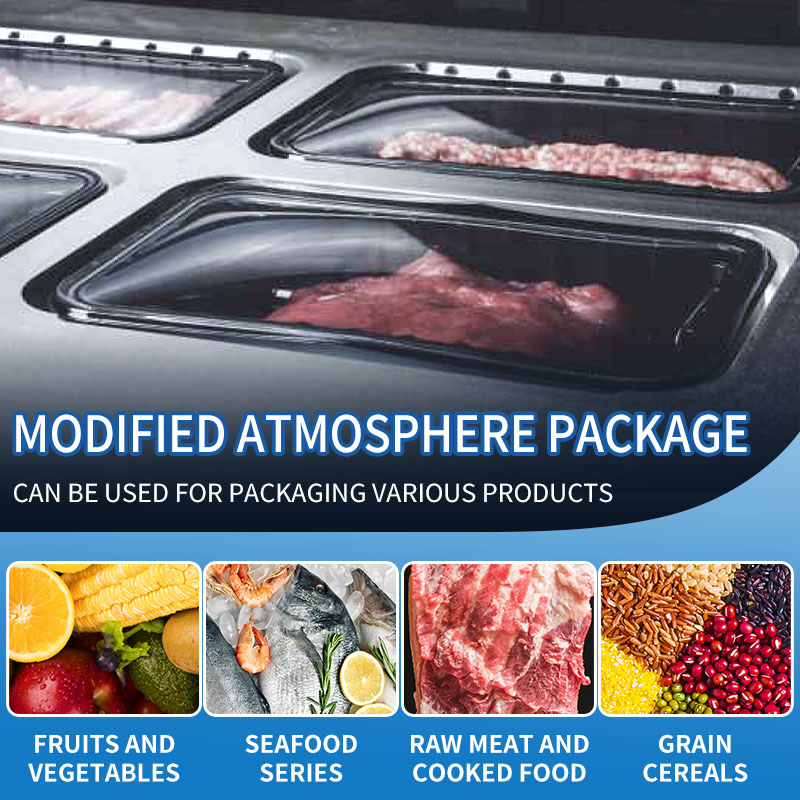
MAP is one of the most impactful technologies available to fresh produce and frozen food producers. By replacing the oxygen inside a package with a carefully calibrated mixture of nitrogen and carbon dioxide, MAP dramatically slows the biological processes that cause spoilage.
**How MAP works:**
1. Product is placed in a tray or pre-made pouch
2. The machine draws out ambient air from the package
3. A nitrogen or nitrogen/CO₂ gas mixture is injected
4. The package is heat-sealed under the modified atmosphere
**Results:**
- Fresh-cut salads: shelf life extended from 3–5 days to 10–14 days
- Fresh berries: shelf life extended from 5–7 days to 14–21 days
- Frozen proteins: freezer burn prevention for 12+ months
- Ready-to-eat meals: shelf life doubled compared to standard packaging
The key is precision. Gas composition must be controlled within tight tolerances—typically 2–5% O₂, 15–30% CO₂, and the balance nitrogen for fresh produce. Too much CO₂ and some products develop off-flavors; too little and the shelf life benefit is lost. This is why purpose-built MAP machines, rather than DIY gas-flush setups, are essential for consistent results.
For small producers, the transition from hand-packing with a vacuum sealer to an automated MAP system represents a step-change in both product quality and production capacity. A single MAP machine can process 20–40 packages per minute, compared to 3–5 per minute for manual sealing.
## Tray Sealing Technology for Modern Food Producers {#section3}
Tray sealers are the workhorse of fresh produce and frozen food packaging. They're designed to handle the rigid and semi-rigid trays that dominate supermarket produce aisles and freezer sections.
**Key features to look for:**
- **Tray versatility:** The ability to handle multiple tray sizes and materials (PET, PP, rPET) with quick changeovers
- **Seal integrity:** Skin-tight seal that prevents leaks and maintains gas atmosphere
- **MAP compatibility:** Built-in gas flushing capability for extended shelf life
- **Throughput:** Semi-auto models handle 15–25 trays/minute; fully automatic models reach 40–60 trays/minute
- **Hygiene design:** Stainless steel construction with tool-free disassembly for cleaning (critical for food safety compliance)
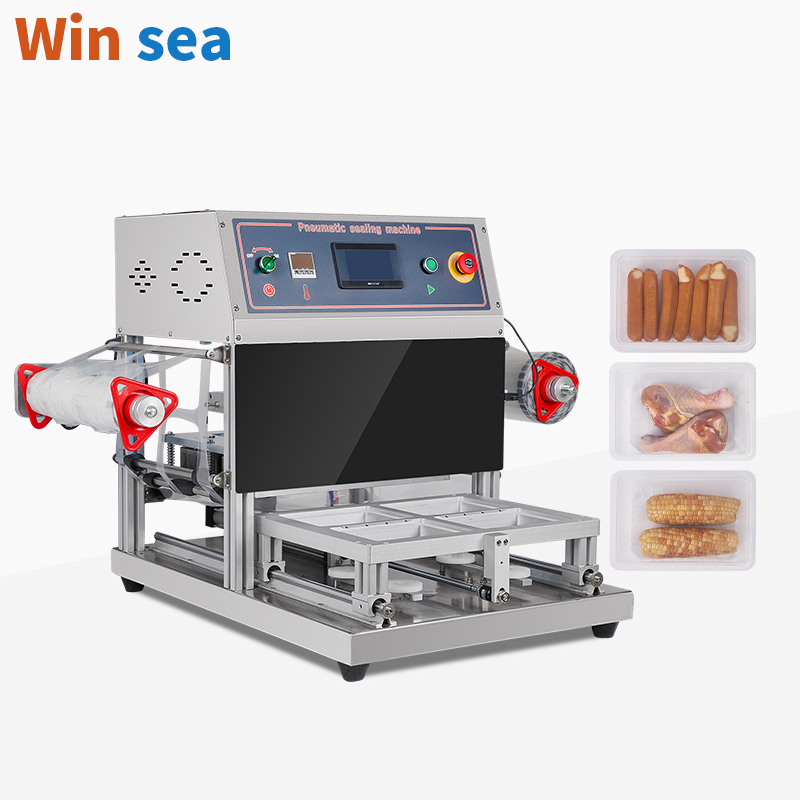
The Food Tray Sealer Machine is an excellent example of how modern tray sealing technology combines MAP capability with operational simplicity. It handles standard food trays, performs automatic nitrogen gas flushing, and delivers consistent seal quality at throughputs suitable for growing operations.
For frozen food operations specifically, the seal quality at sub-zero temperatures is non-negotiable. A weak seal at -18°C means freezer burn within weeks. Purpose-built tray sealers use higher seal temperatures and specialized films to create bonds that remain intact through the temperature cycling of distribution and retail storage.
## Comparing Packaging Approaches: Manual vs. Semi-Auto vs. Fully Auto {#section4}
Choosing the right level of automation depends on your current volume, growth trajectory, and labor costs. Here's how the options compare:
### Manual Packaging
- **Cost:** $2,000–$8,000 (basic chamber vacuum or heat sealer)
- **Throughput:** 3–5 packages per minute
- **Best for:** Farmers' market producers, small farm operations under 500 units/week
- **Limitations:** Inconsistent seal quality, no MAP capability, labor-intensive
### Semi-Automatic Tray Sealing
- **Cost:** $25,000–$75,000
- **Throughput:** 15–25 trays per minute
- **Best for:** Mid-size producers shipping 2,000–10,000 units/week
- **Advantages:** MAP capability, consistent seals, moderate labor requirement (1–2 operators)
### Fully Automatic MAP Packaging
- **Cost:** $80,000–$200,000+
- **Throughput:** 40–60+ trays per minute
- **Best for:** High-volume producers and co-packers handling 10,000+ units/week
- **Advantages:** Minimal labor, maximum throughput, integrated tray denesting, gas flushing, and sealing
For most small and growing producers, the semi-automatic tier represents the sweet spot. The YH-320Q Airflow Nitrogen Filling MAP Packaging Machine, for example, delivers industrial-grade MAP performance in a footprint and price point accessible to operations that are ready to move beyond hand-packing.
## ROI Analysis: What Automated Packaging Saves You {#section5}
Let's run the numbers for a typical small fresh produce operation currently hand-packing 3,000 units per week:
**Current cost (manual):**
- 2 laborers × 8 hours × $16/hour × 5 days = $1,280/week in packaging labor
- Shrink rate: 8% → $4,800/week in spoiled product (based on $6/unit wholesale value)
- Total weekly cost: **$6,080**
**With semi-auto MAP tray sealing:**
- 1 operator × 6 hours × $16/hour × 5 days = $480/week in packaging labor
- Shrink rate reduced to 2% → $1,200/week in spoiled product
- Machine cost amortized over 5 years: ~$288/week (for a $75,000 machine)
- Total weekly cost: **$1,968**
**Weekly savings: $4,112**
**Annual savings: $213,824**
**Payback period: approximately 4 months**
Even accounting for ongoing maintenance, film and gas costs, and a more conservative shrink reduction (say, from 8% to 3%), the payback period for a semi-auto MAP tray sealer typically falls between 6 and 12 months for operations at this volume.
The frozen food scenario is equally compelling. Freezer burn is the number one cause of consumer complaints and retail returns for frozen proteins. A tray sealer that maintains seal integrity at -18°C virtually eliminates this issue, improving customer satisfaction and reducing costly returns.
## How to Choose the Right Packaging Machine for Your Operation {#section6}
When evaluating packaging machines for fresh produce or frozen foods, consider these key factors:
**1. Product characteristics.** Delicate produce (berries, leafy greens) requires gentler handling than robust items (carrots, potatoes). Frozen proteins need cold-chain-compatible seals.
**2. Tray and film compatibility.** Ensure the machine supports the tray sizes and materials your retail customers require. rPET trays are increasingly mandated by retailers pursuing sustainability goals.
**3. Gas flushing precision.** MAP is only effective if gas composition is consistent. Look for machines with closed-loop gas control rather than simple timed injection.
**4. Footprint and utilities.** Small production facilities have space constraints. Measure your available floor space and confirm electrical and compressed air requirements before ordering.
**5. Service and support.** Packaging machines are capital investments. Choose a supplier that offers installation support, training, and readily available spare parts.
**6. Compliance.** FDA, USDA, and SQF/BRC requirements vary by product type. Ensure your machine meets the hygiene and documentation standards your auditors require.
The transition from manual to automated packaging is one of the highest-ROI investments a small food producer can make. It reduces labor costs, eliminates inconsistency, extends shelf life, and positions your brand for growth.
---
### Recommended Equipment
 ## Conclusion
Fresh produce and frozen food producers can no longer afford to rely on manual packaging. The combination of MAP technology and modern tray sealing equipment delivers measurable results: longer shelf life, dramatically less shrink, and packaging that commands premium retail placement. Whether you're shipping 2,000 units a week or 20,000, the right packaging machine pays for itself in months, not years.
Ready to see what automated MAP and tray sealing can do for your operation? [Request a quote](/request-quote/) today and our packaging specialists will help you find the right machine for your product, your facility, and your budget.
---
## Related Resources
- [Food Packaging Machines](/food-packaging-machines/) — Browse our full range of food packaging solutions
- [Labeling Machines](/labeling-machines/) — Automatic and semi-auto labeling for packaged products
- [Production Lines](/production-lines/) — Complete end-to-end packaging line solutions
- [Solutions](/solutions/) — Industry-specific packaging guidance from our experts
## Conclusion
Fresh produce and frozen food producers can no longer afford to rely on manual packaging. The combination of MAP technology and modern tray sealing equipment delivers measurable results: longer shelf life, dramatically less shrink, and packaging that commands premium retail placement. Whether you're shipping 2,000 units a week or 20,000, the right packaging machine pays for itself in months, not years.
Ready to see what automated MAP and tray sealing can do for your operation? [Request a quote](/request-quote/) today and our packaging specialists will help you find the right machine for your product, your facility, and your budget.
---
## Related Resources
- [Food Packaging Machines](/food-packaging-machines/) — Browse our full range of food packaging solutions
- [Labeling Machines](/labeling-machines/) — Automatic and semi-auto labeling for packaged products
- [Production Lines](/production-lines/) — Complete end-to-end packaging line solutions
- [Solutions](/solutions/) — Industry-specific packaging guidance from our experts
YH-320Q Airflow Nitrogen Filling MAP Packaging Machine
Automated MAP packaging with precision nitrogen gas flushing for extended fresh produce shelf life and retail-ready presentation.
View Details →
Food Tray Sealer Machine
Versatile automatic tray sealing with MAP capability—ideal for fresh produce, deli items, and frozen food operations of all sizes.
View Details →Need Packaging Equipment?
SPS helps small food manufacturers source reliable packaging equipment at factory prices.
Get a Free Quote →